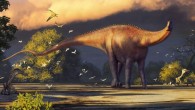
Paleontologists have identified a new genus and species of rebbachisaurid dinosaur from a fossil uncovered in Uzbekistan.
Life reconstruction of Dzharatitanis...
In new research, an international team of scientists examined the dental calculus of individuals who lived during the 2nd millennium BCE in the Southern...
The Aral Sea basin in Central Asia and its major rivers, the Amu Darya and Syr Darya, were the center of advanced river civilizations, and a principal...
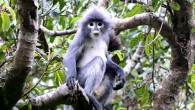
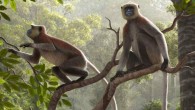
An international team of biologists and taxonomists has discovered a new species in the langur genus Trachypithecus living in the forests of Myanmar.
The...
An international team of archaeologists has found three ancient leather balls in tombs of the prehistoric Yanghai cemetery near the modern city of Turfan...
The 13,000-year-old partial tusk of an adult mammoth found in western Siberia has four images of two-humped camels engraved on it.
The 13,000-year-old...
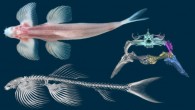
In a study published in the Journal of Morphology, an international team of scientists has pieced together the ancestral relationships that make up the...
A new genus and species of small-bodied fossil ape that lived during the Middle Miocene epoch has been identified from a fossilized tooth found in Ramnagar,...
According to a new study led by University of Cambridge researchers, the processes that drive atoms or molecules to aggregate as a crystal have the same...
New research led by Bournemouth University archaeologists supports the theory that the Hyksos, the rulers of the 15th Dynasty of ancient Egypt, were not...
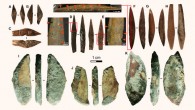
Archaeologists have found over a hundred bone arrow points at the Pleistocene cave site of Fa-Hien Lena in Sri Lanka. The artifacts were used to hunt tree-dwelling...
An international team of archaeologists has uncovered a diminutive carving, depicting a standing bird, at the Paleolithic site of Lingjing in Henan, China....
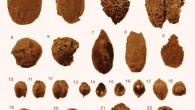
A team of archeologists from China, Uzbekistan, and Germany has found evidence that japonica-like rice was an important food in Central Asia as early as...
Vietnam features extensive ethnolinguistic diversity and occupies a key position in Mainland Southeast Asia (MSEA). Yet, the genetic diversity of the country...
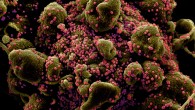
In a phylogenetic network analysis of the first 160 complete genomes of SARS-CoV-2 to be sequenced from human patients, an international team of scientists...
Using a novel method for detecting Neanderthal ancestry in modern humans, a team of U.S. researchers has demonstrated that remnants of Neanderthal genomes...
Homo erectus, a hominin species that originated in equatorial Africa or the Caucasus region of Eurasia, arrived on the island of Java in Indonesia around...
An international team of researchers has pinpointed the first comprehensive age for the last known occurrence of the early hominin species Homo erectus.
This...