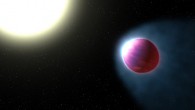
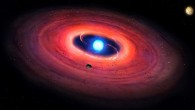
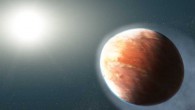
Astronomers using the HARPS (High Accuracy Radial velocity Planet Searcher) spectrograph at ESO’s La Silla Observatory in Chile have detected gaseous...
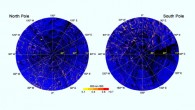
A ferric mineral called hematite (Fe2O3) is present at high latitudes on the Moon, mostly associated with east- and equator-facing sides of topographic...
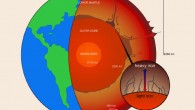
The inner core of our planet is between 1 and 1.3 billion years old, according to new research led by the University of Texas at Austin and Carnegie Institution...
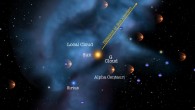
An international team of scientists has found interstellar iron-60, a radioactive isotope with a half-life of 2.6 million years that is predominantly produced...
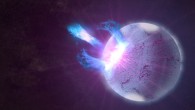
A series of ‘black dwarf’ supernovae will be the last astrophysical events to occur in our Universe prior to the so-called heat death, when the Universe...
Using data from the Miniature Radio Frequency (Mini-RF) instrument onboard NASA’s Lunar Reconnaissance Orbiter (LRO), a team of U.S. researchers has...
Earth’s molten core may be leaking heavy isotopes of iron, according to a study led by geoscientists from Aarhus University and the University of California,...
A research team led by Harvard University scientist Julie McGeoch has found a never-before-seen protein inside a meteorite called Acfer 086.
A sample of...
WASP-76b, a gas-giant exoplanet located some 640 light-years away in the constellation of Pisces, has a day side where temperatures climb above 2,400 degrees...
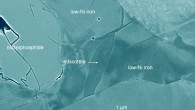
A team of researchers from the University of Washington and NASA’s Ames Research Center has analyzed iron-rich micrometeorites collected from 2.7 billion-year-old...
SN 2006gy, a superluminous supernova discovered in 2006, gained its exceptional brightness when a normal Type Ia explosion smashed into a dense shell of...
Young lava flows detected by ESA’s Venus Express spacecraft are just few years old, according to new research from Universities Space Research Association...
Tiny iron particles fall from Earth’s molten outer core and pile on top of the planet’s solid inner core, according to new research published in the...
There isn’t a strong correlation between gas giant and host star compositions when it comes to elements heavier than hydrogen and helium, according to...
White dwarfs are dense, burned-out remnants of normal stars. Due to their strong gravitational pull, surface atmospheres of these ancient objects should...
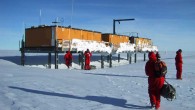
A team of researchers from Germany, Austria and Australia has found traces of the radioactive isotope iron-60 — the tell-tale signature of a supernova...
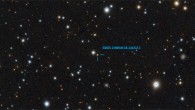
SMSS J160540.18-144323.1, an ultra-metal-poor red giant star located in the halo of the Milky Way, on the other side of the Galaxy about 35,000 light-years...
WASP-121b is about two times bigger than Jupiter and 1.2 times more massive. Discovered in 2016, the planet is located 881 light-years away in the constellation...
A process called nucleation plays a critical role in many physical and biological phenomena that range from crystallization, melting and evaporation to...