Berries of the sea buckthorn (Hippophae rhamnoides) grown in Canada showed promising health benefits induced by their rich and diverse polyphenolic profile...
The Sturtian ‘Snowball Earth’ glaciation (717 to 661 million years ago) is regarded as the most extreme interval of icehouse climate in Earth’s history....
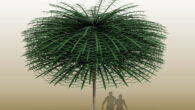
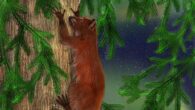
Sanfordiacaulis densifolia is an extinct tree species that existed between 359 and 347 million years ago (Carboniferous period) in what is now New Brunswick,...
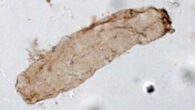
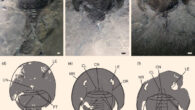
The earliest known evidence of photosynthetic structures has been identified inside a collection of the enigmatic cylindrical microfossils Navifusa majensis...
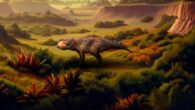
Paleontologists have found the fossil of a previously unknown species of leptoceratopsid dinosaur that lived more than 70 million years ago in what is...
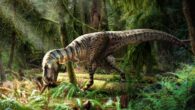
Paleontologists in Canada have found a 75-million-year-old skeleton of a juvenile of the tyrannosaurid dinosaur Gorgosaurus libratus with the remains of...
In their new research, scientists at Texas A&M University developed a highly contiguous chromosome-level reference genome for the North American bison...
The 510-million-year-old fossils from the Forteau Formation of Newfoundland and Labrador, Canada, are microscopic, look like spiny balls connected together,...
Chaetae are stiff bristles made of chitin that characterize many species of annelid worms.
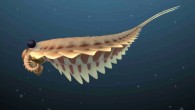
Reconstruction of Shaihuludia shurikeni from the Spence Shale...
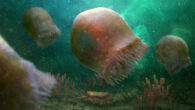
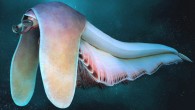
Burgessomedusa phasmiformis had a cuboidal umbrella up to 20 cm (8 inches) high and over 90 short, finger-like tentacles.
Artistic reconstruction of a...
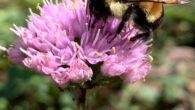
The rusty patched bumblebee (Bombus affinis) is an important pollinator in North America and a federally listed endangered species. Putting together its...
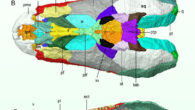
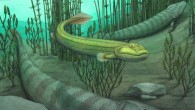
Crassigyrinus scoticus was a large aquatic predator known from the lower- to mid-Carboniferous period of Scotland and Canada.
3D reconstruction of the...
Paleontologists have described two new species of the early primatomorphan genus Ignacius from Ellesmere Island, Nunavut, Canada.
Life reconstruction of...
Horseshoe crabs, or xiphosurans, are an order of marine and brackish water arthropods. Despite their common name, they are not really crabs, and are more...
Qikiqtania wakei closely resembles Tiktaalik roseae — the important transitional animal considered a missing link between fish and the earliest limbed...
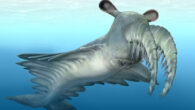
Balhuticaris voltae is the largest bivalved arthropod to date, at almost double the size of the previous record-holder, Nereocaris exilis.
Life reconstruction...
Nun cho ga is the most complete mummified mammoth found in North America.
Steppe mammoths. Image credit: Beth Zaiken / Centre for Palaeogenetics.
The near...