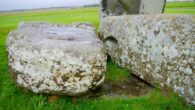
A new analysis by University of South Wales Professor Duncan Pirrie and his colleagues undercuts the leading theory that the 6-ton slab of sandstone came...
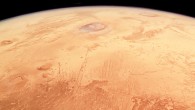
Hydrogen chloride (HCl) gas was seen during Mars’ cold aphelion season, when none was expected; the detection is best explained by ongoing igneous processes...
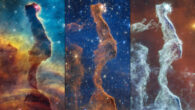
The NASA/ESA Hubble Space Telescope and the NASA/ESA/CSA James Webb Space Telescope have turned their cameras on an eerie pillar of gas and dust with a...
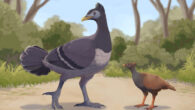
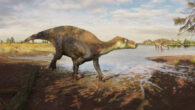
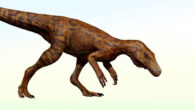
The fossilized remains belong to Aratasaurus museunacionali, a species of coelurosaurian theropod dinosaur that lived in what is now northeastern Brazil...
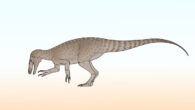
Paleontologists have identified a new genus and species of megaraptorid dinosaur from an incomplete skeleton unearthed in northern Patagonia, Argentina.
Life...
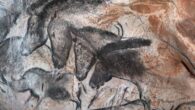
Some of the oldest drawings known to humanity, made roughly 37,000 years ago in France’s Chauvet Cave, are covered by a thin, translucent film of calcite...
A new study led by the University of Cambridge challenges the long-standing idea that comets helped kick-start life on our home planet, suggesting that...
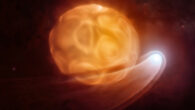
New radio observations with NSF’s Karl G. Jansky Very Large Array (VLA) and the Atacama Large Millimeter/submillimeter Array (ALMA) show the red supergiant...
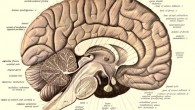
Humans and chimpanzees share more than 96% of their protein-coding DNA, yet human brains are roughly three times larger and far more complex. New research...
A partial dinosaur skeleton unearthed in a Surrey brickworks in 2001 has been identified as a previously unknown genus and species of an early-diverging...
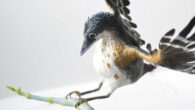
Concornis lacustris, a small enantiornithine bird that lived alongside dinosaurs more than 100 million years ago, has received a life-size makeover, thanks...
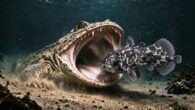
Paleontologists have described what they say is the first fully marine species of a stem amphibian, Gerrothorax maritimus, based on two nearly complete...
The enrichment in metals (any element heavier than hydrogen and helium, including carbon, oxygen, iron and gold) likely came from generations of exploding...
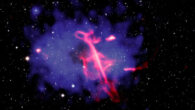
VLSS J0318.9+5755, a strange, musical-note-shaped radio source hiding behind the Milky Way’s dusty disk, has turned out to be the glowing remains of...
A single bone from southern Brazil indicates that herrerasaurids, among the first large meat-eating dinosaurs, persisted after the fauna around them changed.
An...
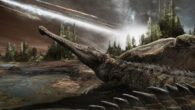
New research suggests that the ancestors of alligators and crocodiles stayed loyal to a warm climate through mass extinctions and hothouse worlds, a loyalty...
An overlooked particle could have altered the early Universe in ways that helped produce the imbalance between matter and antimatter, a new theoretical...
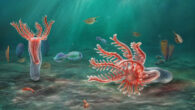
A 518-million-year-old ambulacrarian fossil from China suggests that the common ancestor of starfish and their relatives was not a burrowing worm; it was...
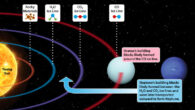
Uranus and Neptune are often described as near-twins, but a new study suggests their chemistry, and possibly their histories, may differ more than expected.
The...