Non-figurative markings on the walls of La Roche-Cotard cave in France are the oldest known engravings made by our sister species.
The 57,000-year-old...
Soft tissues rarely preserve in the fossil record, rather scientists are mostly left with just the skeletal material. Yet, muscles animate the body. They...
Early humans and their hominin relatives had to adapt to new environments to spread out of Africa. In a new study, paleoanthropologists from the Institute...
Among animals, humans stand out in their consummate propensity to self-induce altered states of mind. Archaeology, history and ethnography show these activities...
Different genetic traits can be beneficial (for example, fending off disease) or harmful (making humans more susceptible to illness), depending on the...
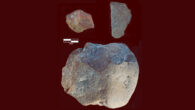
Oldowan tools, consisting of stones with one to a few flakes removed, are the oldest widespread and temporally persistent hominin tools. The oldest of...
Archaeologists have unearthed a rich assemblage of human-accumulated terrestrial and marine faunal remains, including those of several crab species, in...
Straight-tusked elephants (Palaeoloxodon antiquus) were the largest terrestrial mammals of the Pleistocene epoch, present in Europe and western Asia between...
Researchers from the University of Tübingen and elsewhere have unearthed the cutmarked bones of cave bears at the Middle Pleistocene site of Schöningen...
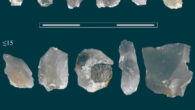
Scientists at the University of Tübingen have performed a careful and in-depth analysis of tiny resharpening flakes from the famous Middle Pleistocene...
Modern humans have admixed with multiple species of archaic hominins. Papuans, in particular, owe up to 5% of their genome to Denisovans, a sister group...
Archaeologists have found the 780,000-year-old remains of a cooked carp-like fish at the wetland Acheulean site of Gesher Benot Ya’aqov in Israel.
Ancient...
The possible track-makers are individuals from the Neanderthal lineage, according to new research led by Universidad de Huelva paleoanthropologists.
The...
Paleoanthropologists have explored the social organization of Neanderthals using ancient nuclear, Y-chromosomal and mitochondrial DNA data from the remains...
Paleoanthropologists have analyzed zinc, strontium, carbon, and oxygen isotope and trace element ratios in a fossilized Neanderthal tooth as well as animal...
A new modeling study by Leiden University and University of Cambridge scientists predicts the appearance of Homo sapiens and the Protoaurignacian culture...
Neanderthal brains were similar in size to those of modern humans but differed in shape. What scientists cannot tell from fossils is how Neanderthal brains...
Paleoanthropologists have examined three fossilized limb bones of Sahelanthropus tchadensis, one of the oldest known species in the human family tree.
Representation...
Studies of human fossils, and the DNA extracted from them, reveal a complex history of interbreeding between various human lineages over the past 100,000...