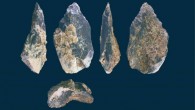
Homo erectus, an early member of the genus Homo, successfully navigated harsher and more arid terrains for longer in Eastern Africa than previously thought,...
Archaeologists say they have extracted a wide variety of starch grains from stone tools found at an early Middle Pleistocene site in Israel. These include...
New research by scientists from the University of Reading and the University of Durham shows that encephalization (i.e., relative brain size increase)...
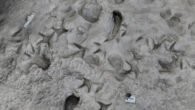
Paleoanthropologists have discovered 1.5-million-year-old footprints of two completely different species of hominins — Homo erectus and Paranthropus...
Recent discoveries of two diminutive hominin species, Homo floresiensis and Homo luzonensis, raise questions regarding how extreme body size reduction...
A new study, published in the journal Earth-Science Reviews, helps resolve one of the longest controversies in paleoanthropology: when did early hominins...
Archaeologists have dated an assemblage of ancient stone tools excavated from the archaeological site of Korolevo on the Tysa River in western Ukraine...
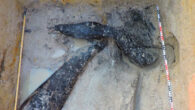
Archaeologists have found an ancient wooden structure at the archaeological site of Kalambo Falls in Zambia. This structure — dated to about 476,000...
Early humans and apes likely evolved free-moving shoulders and flexible elbows to slow their descent from trees as gravity pulled on their heavier bodies,...
Today, there are more than 8 billion human beings on the planet. Our species dominate Earth’s landscapes, and our activities are driving large numbers...
New paleoclimate evidence shows that around 1.1 million years ago, the southern European climate cooled significantly and caused an extinction of archaic...
Paleoanthropologists have found multiple cut marks on a 1.45-million-year-old (Early Pleistocene) hominin fossil found in the Koobi Fora Formation in the...
Early humans and their hominin relatives had to adapt to new environments to spread out of Africa. In a new study, paleoanthropologists from the Institute...
The archaeological site of Fordwich in northeast Kent, England, reveals the presence of Acheulean hominins — possibly Homo erectus or Homo heidelbergensis...
Paleoanthropologists have uncovered two new specimens of Homo erectus at the East Turkana site in Kenya. They’ve also verified the age of a skull fragment...
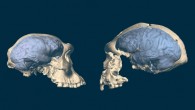
Modern human brain structures emerged later than the first dispersal of the genus Homo from Africa, and were probably in place by 1.7 to 1.5 million years...
The hominin fossil record of Island Southeast Asia (ISEA) indicates that at least two super-archaic species, Homo luzonensis and Homo floresiensis, were...
In a new study published in the journal PLoS Genetics, researchers analyzed the genomes of two Neanderthals, a Denisovan, and two African humans; and found...
Paleoanthropologists working at the Konso research area in Ethiopia have found a 1.4-million-year-old large bone fragment shaped into handaxe-like form.
The...