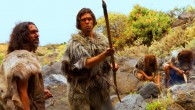
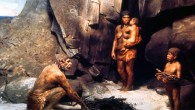
Neanderthals, our evolutionary cousins, used toothpicks nearly 46,000 years ago, a new study of their teeth has revealed.
A reconstruction of a Neanderthal...
The hominin fossil record of Island Southeast Asia (ISEA) indicates that at least two super-archaic species, Homo luzonensis and Homo floresiensis, were...
Neanderthals evolved the auditory capacities to support a vocal communication system as efficient as modern human speech, according to new research led...
In a genome-wide association study of 6,169 Latin American individuals, an international team of scientists identified 32 gene regions (loci) that influenced...
The 120,000-year-old animal bone fragment with six incised lines is one of the oldest representations of abstract patterns produced by Middle Paleolithic...
Several hominin teeth found the Paleolithic site of La Cotte de St Brelade in Jersey may belong to Neanderthal-Homo sapiens hybrids, according to new research...
An international team of archaeologists and paleoanthropologists has discovered a large collection of 2-million-year-old stone tools, fossilized bones...
Paleolithic people deliberately crossed the challenging ocean to migrate to the Ryukyu Islands of southwestern Japan, even though the islands would not...
Neanderthals may have found precision grips (where objects are held between the tip of the finger and thumb) more challenging than power squeeze grips...
Paranthropus robustus is a small-brained extinct hominin that lived between 2 million and 1.2 million years ago in what is now South Africa. Discovered...
A new study published in the Proceedings of the National Academy of Sciences reveals that the modern human nursing strategy, with onset of weaning at 5...
The median artery of the human forearm is an example of microevolutionary changes in the internal anatomy of the human body, according to new research...
An international team of researchers has virtually reconstructed the ribcages of four Neanderthal individuals from birth to around 3 years old and found...
The genomes of our closest relatives, Neanderthals and Denisovans, have been sequenced and compared with that of modern humans. However, most archaic individuals...
An international team of archaeologists and paleoanthropologists has found ancient human and animal footprints on the surface of an ancient lakebed in...
New research pieces together the activities and movements of a group of Homo heidelbergensis, a poorly understood species of archaic humans that lived...
An international team of archaeologists reports the discovery of grass bedding used to create comfortable areas for sleeping and working by Paleolithic...