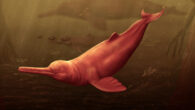
Pebanista yacuruna is the closest relative of living South Asian river dolphins (genus Platanista).
Artistic reconstruction of Pebanista yacuruna. Image...
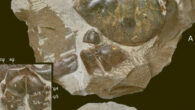
Paleontologists have described a new species of the crab genus Pseudocarcinus from large-sized fossilized specimens found at Taranaki, North Island, New...
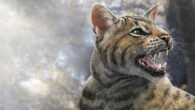
Paleontologists at the Museo Nacional de Ciencias Naturales-CSIC have identified a new genus and species of medium-sized feline from a partial jaw found...
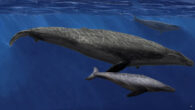
Baleen whales (mysticetes) include the largest animals on the Earth. How they achieved such gigantic sizes remains debated, with previous research focusing...
In the search for life in the Universe, Earth provides a template of evolution for the one habitable planet we know. Earth’s atmospheric composition...
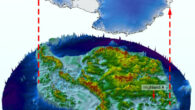
Geoscientists from Durham University and elsewhere have discovered a landscape that appears to have been formed by rivers at least 14 million years ago...
Pierolapithecus catalaunicus is an extinct species of great ape that lived in what is now Europe about 12 million years ago. A remarkably complete, although...
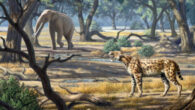
The new fossil material belonging to Anachlysictis gracilis, including an almost complete specimen consisting of a nicely preserved skull and postcranial...
Paleontologists have identified four new fossil feathertail possum species (family Acrobatidae) from the fossilized specimens found in the Late Oligocene...
For the first time, footprints made by an extinct terror bird (family Phorusrhacidae) have been identified by paleontologists.
Holotype trackway of Rionegrina...
Researchers from the Universidad del Rosario, the Universidad Nacional de Colombia, Smithsonian Tropical Research Institute, the Field Museum of Natural...
Paleontologists have unearthed the fossilized remains of a new species of the mekosuchine crocodilian genus Baru in the Alcoota Scientific Reserve, about...
The fossilized remains of the Miocene-period ape species Anadoluvius turkae have been unearthed at the paleotological site of Çorakyerler in central Anatolia,...
Seals, sea lions and walruses (Pinnipedia) use their whiskers (vibrissae) to explore their environment and locate their prey. Today they live mostly in...
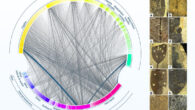
Plant-eating insects are the most diverse group of multicellular organisms on Earth. The most discussed drivers of their inordinate taxonomic and functional...
Paleontologists have discovered an exceptionally well-preserved monodominant forest of the wood fossil-species Wataria parvipora at a Miocene locality...
Paleontologists have unearthed the 5.2-million-year-old fossilized remains of four sabertooth cat species — including two previously unknown species,...
Otodus megalodon, a megatooth shark that lived between 23 and 3.6 million years ago, was not a fast swimmer, but it had a mega-appetite explaining its...
The evolution of life on Earth has changed dramatically at tens of million-year time scales. However, the causal mechanisms of these changes remain unclear....
In a new study, paleontologists from the United Kingdom and Sweden reviewed the fossil evidence of locomotion of kangaroos and their relatives (wallabies,...