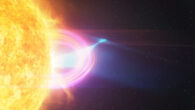
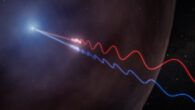
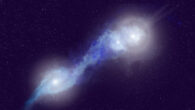
Astronomers at the Curtin University node at the International Centre for Radio Astronomy Research (ICRAR) have found a white dwarf that beams out radio...
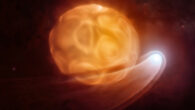
New radio observations with NSF’s Karl G. Jansky Very Large Array (VLA) and the Atacama Large Millimeter/submillimeter Array (ALMA) show the red supergiant...
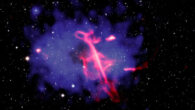
VLSS J0318.9+5755, a strange, musical-note-shaped radio source hiding behind the Milky Way’s dusty disk, has turned out to be the glowing remains of...
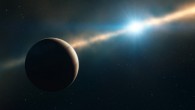
For the first time, astronomers have directly detected radio emission from a planet beyond our Solar System.
This artist’s impression shows how the gas...
Using NSF’s Very Large Array (VLA), astronomers made the first radio detection of polarized light and Faraday rotation from a gamma-ray burst afterglow,...
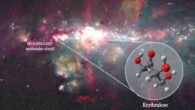
Using the Yebes 40-m and IRAM 30-m radio telescopes, astronomers have discovered erythrulose, a four-carbon sugar commonly found in raspberries and sunless...
Using the Karl G. Jansky Very Large Array (VLA) s and the Five-hundred-meter Aperture Spherical Radio Telescope (FAST), astronomers have created the sharpest-ever...
Using NASA’s Goldstone Solar System Radar and NSF’s Green Bank Telescope, astronomers from the University of California, Los Angeles, confirmed that...
Using the SETI Institute’s Allen Telescope Array, a 42-element radio interferometer at Hat Creek Radio Observatory in Hat Creek, California, astronomers...
For the first time, astronomers have directly detected how turbulent clouds of ionized gas between the stars bend and blur radio signal from a distant...
Stellar activity and plasma turbulence could distort narrow radio signals before they leave their home planetary systems, potentially explaining part of...
New research from the University of Kansas untangles a decades-old astrophysical puzzle, showing how competing forces — gravity’s pull and magnetospheric...
Using high-precision radio-occultation measurements from NASA’s Juno mission and incorporating the effects of zonal winds, planetary scientists derived...
SETI@home, the pioneering distributed-computing project launched in 1999 that enlisted millions of volunteers to analyze radio signals from space, produced...
A rare trio of merging galaxies called J121/1219+1035 hosts three actively feeding, radio-bright supermassive black holes, according to a team of U.S....
Using data gathered by a suite of space- and ground-based telescopes, astronomers have discovered AT 2024wpp, the most luminous fast blue optical transient...
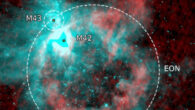
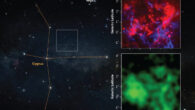
Astronomers using the Green Bank Telescope (GBT) have created the large-scale maps of carbon monoxide (CO)-dark molecular gas for the star-forming complex...
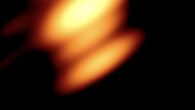
Using data from the RadioAstron satellite, astronomers have produced a radio image of two supermassive black holes at the center of the distant quasar...
Using the Murchison Widefield Array (MWA) telescope at CSIRO’s Murchison Radio-Astronomy Observatory, astronomers are searching for the elusive Epoch...
As part of the Widefield ASKAP L-band Legacy All-sky Survey (WALLABY), an international team of astronomers has observed the dwarf galaxy pair NGC 4532...