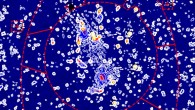
Astronomers using a radio telescope at the Arecibo Observatory have captured the first images of the recently-discovered near-Earth asteroid 2020 BX12....
Using the Low Frequency Array (LOFAR) radio telescope, astronomers have observed radio waves that carry the distinct signatures of extraterrestrial aurorae,...
The Breakthrough Listen Initiative, the largest ever scientific research program aimed at finding evidence of alien civilizations, has released data from...
A new radio image from the MeerKAT telescope at the South African Radio Astronomy Observatory in Cape Town, South Africa, presents a wide portrait of the...
The NASA-designed Goddard-IRAM Superconducting 2-Millimeter Observer (GISMO), a bolometer camera installed on the 30-m IRAM radio telescope, has produced...
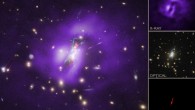
Supermassive black holes in the center of galaxy clusters usually suppress star formation, but the one in the Phoenix Cluster, a group of about 1,000 galaxies...
Astronomers using the MeerKAT telescope at the South African Radio Astronomy Observatory have spotted an object which rapidly brightened by more than a...
An international team of astronomers has detected 27 new supernova remnants using a data release of the GaLactic and Extragalactic All-sky MWA survey (GLEAM)...
Astronomers using the MeerKAT telescope at the South African Radio Astronomy Observatory have spotted a pair of enormous radio-emitting bubbles in the...
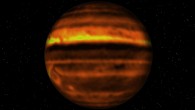
An international team of astronomers has managed to peer deep into the Jovian atmosphere using the Atacama Large Millimeter/submillimeter Array (ALMA)...
The Hubble constant measures the current expansion rate of our Universe and plays a fundamental role in cosmology: it can be used to determine the Universe’s...
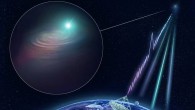
Fast radio bursts (FRBs) are brief radio emissions from distant astronomical sources. Some are known to repeat, but most are single bursts, occurring only...
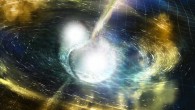
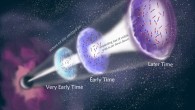
Gamma-ray bursts (GRBs) are the most energetic explosions in the Universe, beaming out mighty jets which travel through space at 0.99 times the speed of...
Astronomers using the Low-Frequency Array (LOFAR) telescope network have detected a vast ridge of radio emission connecting the merging galaxy clusters...
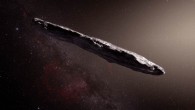
In October 2017, a fast moving object of extrasolar origin, named ‘Oumuamua, was discovered close to the Earth with a ground-based telescope in Hawai’i....
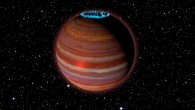
Astronomers using NSF’s Karl G. Jansky Very Large Array have detected a ‘rogue’ planetary-mass object with a surprisingly powerful magnetic field.
Artist’s...
A multinational group of astronomers has imaged the formation and expansion of a fast-moving jet of material ejected when the intense gravity of a supermassive...
Ever since NASA’s Voyager 1 flew past Jupiter in 1979, planetary researchers have wondered about the origin of Jovian lightning. That encounter confirmed...
Astronomers have detected radio echoes of a supermassive black hole feeding on a star, suggesting the black hole emits a jet of energy proportional to...