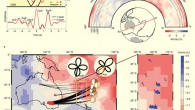
Ultra-low velocity zones sit beneath the central Pacific and Africa, atop the outer core of Earth. In these areas, seismic waves slow by as much as half,...
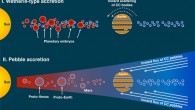
Two fundamentally different processes of rocky planet formation exist, but it is unclear which one built the Earth and other terrestrial solar system planets....
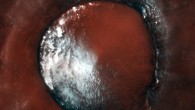
ESA’s Trace Gas Orbiter has returned a stunning image of a 4-km- (2.5-mile) wide crater located in Vastitas Borealis, the largest lowland region of Mars.
The...
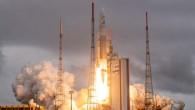
The James Webb Space Telescope, an international partnership between NASA, ESA and the Canadian Space Agency (CSA), launched at 7:20 a.m. EST (13:20 CET)...
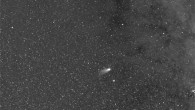
When C/2021 A1 (Leonard), a recently-discovered long-period comet about 1 km wide, makes its closest pass of the Sun on January 3, 2022, it will be a journey...
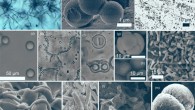
Possible lifeforms in the Venusian clouds could be setting off a cascade of chemical reactions that is making the environment much more habitable, according...
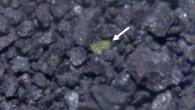
An analysis of the Hayabusa-2 sample of material returned to Earth from the carbon-rich, diamond-shaped, near-Earth asteroid Ryugu shows that the material...
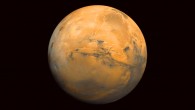
Planetary researchers using the Fine Resolution Epithermal Neutron Detector (FREND) instrument onboard ESA’s Trace Gas Orbiter (TGO) have found evidence...
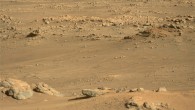
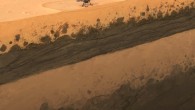
On December 5, 2021, NASA’s Ingenuity helicopter successfully flew to a new destination located very close to its original airfield, Wright Brothers...
University of Exeter’s Dr. Adrien Morison and colleagues have shown how vast ice forms have been shaped in Sputnik Planitia, a nitrogen-ice-filled basin...
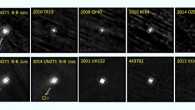
Comet C/2014 UN271 Bernardinelli-Bernstein, the largest comet ever discovered, was already exhibiting coma at heliocentric distances 23.8 and 21.2 AU,...
The solar wind, comprised of solar particles largely made of hydrogen ions, created water on the surface of dust grains carried on asteroids that smashed...
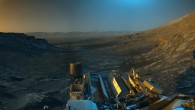
Members of NASA’s Curiosity rover mission team have combined two versions of the black-and-white images of Martian mountains from different times of...
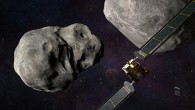
NASA’s Double Asteroid Redirection Test (DART) mission launched November 24, 2021 at 1:21 a.m. EST on a SpaceX Falcon 9 rocket from Space Launch Complex...
Using seismic data collected by the SEIS (Seismic Experiment for Interior Structure) instrument aboard NASA’s InSight (Interior Exploration using Seismic...
Hydrogen is the most abundant element. When a neutral hydrogen atom gets blasted with energy, its electron can be boosted to a larger orbit with a higher...
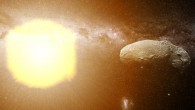
Using the Large Binocular Telescope and the Lowell Discovery Telescope, astronomers have conducted a comprehensive physical characterization of the near-Earth...