Astronomy News

May 15, 2023 by Enrico de Lazaro

AT2021lwx occurred nearly 8 billion years ago and was more than 10 times brighter than any known supernova explosion. The event was likely caused by the accretion of a giant molecular cloud on to a dormant supermassive black hole. An artist’s impression of a black hole accretion. Image credit: John A. Paice. AT2021lwx was first detected in 2020 by the Zwicky Transient Facility, and was subsequently detected by the Asteroid Terrestrial-impact Last...

May 15, 2023 by Enrico de Lazaro

Using the NASA/ESA Hubble Space Telescope, astronomers have captured a striking new photo of the densely packed globular cluster NGC 6325. This Hubble...

May 12, 2023 by News Staff

Fast radio bursts (FRBs) are brief flashes of radio waves from distant galaxies that are probably emitted by neutron stars. Some FRBs repeat, which enables...

May 11, 2023 by News Staff

As part of the VISIONS survey program, astronomers have surveyed five nearby star-forming molecular cloud complexes associated with the constellations...

May 11, 2023 by News Staff

Astronomers at Newcastle University and Colby College have developed a new technique to determine how likely it is that two galaxies are very close together...

May 11, 2023 by News Staff

Gliese 1214b is a so-called mini-Neptune, a smaller, denser version of Neptune that consists of a rocky core surrounded by a thick blanket of gas. This...

May 10, 2023 by Enrico de Lazaro

The Hubble team has released a beautiful new image of two massive galaxies, NGC 545 and NGC 547, collectively known as Arp 308. This Hubble image shows...

May 9, 2023 by Enrico de Lazaro

New high-resolution images of the Fomalhaut A system from the NASA/ESA/CSA James Webb Space Telescope show three debris belts extending out to 23 billion...

May 8, 2023 by Enrico de Lazaro

eMACS J1823.1+7822 has so much mass that it acts as a gravitational lens, causing light from distant galaxies to bend around it. This Hubble image shows...

May 8, 2023 by Enrico de Lazaro

Astronomers using the NASA/ESA Hubble Space Telescope have captured a beautiful new image of the lenticular galaxy NGC 5283. This Hubble image shows NGC...

May 4, 2023 by News Staff

NSF’s Karl G. Jansky Very Large Array (VLA), a powerful radio telescope situated about 80.5 km (50 miles) west of Socorro, New Mexico, is joining the...

May 4, 2023 by Enrico de Lazaro

Centaurus A is located 13 million light-years away in the constellation of Centaurus, and represents the fifth brightest galaxy in the sky. This composite...

May 4, 2023 by News Staff

Astronomers using ESO’s Very Large Telescope (VLT) have detected three distant gas clouds whose chemical composition matches what they expect from the...

May 3, 2023 by Enrico de Lazaro

Astronomers using the FORS2 instrument on ESO’s Very Large Telescope have captured a striking new image of the large emission nebula Gum 10. This image,...

May 3, 2023 by Enrico de Lazaro

Mobile communication towers represent a relatively new but growing contributor to the total radio-leakage associated with planet Earth. In new research,...

May 2, 2023 by News Staff

Life most likely started during the Hadean Eon (4.5 to 4 billion years ago). However, the environmental conditions which contributed to the complexity...

May 2, 2023 by Enrico de Lazaro

Using spectral data from Webb’s Near-Infrared Spectrograph (NIRSpec), astronomers determined that the warm super-Earth Gliese 486b either has a water-rich...

May 2, 2023 by Enrico de Lazaro

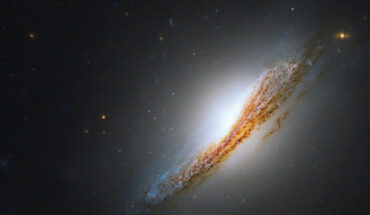
Astronomers using the NASAESA Hubble Space Telescope have captured a detailed image of a lenticular galaxy called NGC 3489. This Hubble image shows NGC...

May 1, 2023 by Enrico de Lazaro

The NASA/ESA Hubble Space Telescope has produced an outstanding image of the jellyfish galaxy JO175. This Hubble image shows JO175, a jellyfish galaxy...

Apr 28, 2023 by Enrico de Lazaro

V1355 Orionis (also known as HD 291095) is an RS CVn-type binary star system located 400 light-years away in the constellation of Orion. An artist’s...