Astronomy News

Oct 18, 2022 by Enrico de Lazaro

3200 Phaethon, one of the largest potentially hazardous asteroids, rotates once every 3.6 hours, and that rotation period is decreasing by about 4 milliseconds per year. This near-Earth asteroid is just the 11th asteroid with a measured change in its rotation period, and it is the largest of them. The next-largest asteroid with a measured change in its rotation period is the near-Earth asteroid 1685 Toro. An artist’s illustration of what the near-Earth...

Oct 18, 2022 by News Staff

The dwarf planet Haumea resides in the Kuiper Belt beyond the orbit of the outermost planet Neptune. An artist’s conception of Haumea, its moons Hi’iaka...

Oct 18, 2022 by News Staff

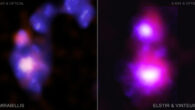
This is the first time such an effect, known as precession, has been seen in black holes, where the twisting is 10 billion times faster than in previous...

Oct 17, 2022 by Natali Anderson

Using data from NASA’s Transiting Exoplanet Survey Satellite (TESS) and several ground-based telescopes, astronomers have detected and characterized...

Oct 17, 2022 by Enrico de Lazaro

Herbig-Haro objects HH 1 and HH 2 are located 1,250 light-years away in the constellation of Orion. Two wispy, gaseous clouds occupy the corners of this...

Oct 16, 2022 by News Staff

GRB 221009A, a gamma-ray burst detected on October 9, 2022, is one of the nearest and possibly the most-energetic gamma-ray burst ever observed. It occurred...

Oct 14, 2022 by News Staff

GW170817, a titanic collision between two neutron stars detected in August 2017, ejected a structured relativistic jet with a speed greater than 99.97%...

Oct 13, 2022 by News Staff

Barium, a chemical element with the symbol Ba and atomic number 56, is the heaviest element detected to date in any exoplanetary atmosphere. This artist’s...

Oct 12, 2022 by News Staff

An image of the binary system WR 140, captured by the NASA/ESA/CSA James Webb Space Telescope in July 2022, has baffled astronomers worldwide — even...

Oct 11, 2022 by Natali Anderson

The triple star system LTT 1445, at a distance of 22.5 light-years, hosts some of the nearest rocky planets. This Chandra image shows the LTT 1445 system:...

Oct 11, 2022 by News Staff

Astronomers have analyzed publicly available data from the Mid-Infrared Instrument (MIRI) on the NASA/ESA/CSA James Webb Space Telescope for three Seyfert...

Oct 11, 2022 by News Staff

Methylated gases are made when organisms add a carbon and three hydrogen atoms to an undesirable chemical element. Called methylation, this process can...

Oct 10, 2022 by Sergio Prostak

Both the first and second interstellar meteors, IM1 and IM2, are outliers in material strength and may have originated in supernova explosions, according...

Oct 10, 2022 by Natali Anderson

Astronomers using the Spectro-Polarimetric High-contrast Exoplanet REsearch (SPHERE) instrument on ESO’s Very Large Telescope have imaged Jupiter’s...

Oct 10, 2022 by Enrico de Lazaro

Terzan 1 is a globular cluster about 21,800 light-years from Earth in the constellation of Scorpius. This Hubble image shows Terzan 1, a globular cluster...

Oct 6, 2022 by News Staff

ZTF J1813+4251 is a 51-minute-orbital-period, fully eclipsing binary system consisting of a star with a temperature comparable to that of the Sun but...

Oct 5, 2022 by News Staff

Dust is a key ingredient in both observed and physical properties of galaxies. It obscures and scatters stellar light, and enables star formation by acting...

Oct 5, 2022 by News Staff

The Stephan’s Quintet, the Cartwheel Galaxy, the galaxy cluster SMACS J0723.3-7327, and the Carina Nebula were among the first publicly released images...

Oct 5, 2022 by News Staff

Nitrous oxide (also known as laughing gas) — a product of microbial nitrogen metabolism — is a compelling exoplanet biosignature gas with distinctive...

Oct 4, 2022 by News Staff

The Small and Large Magellanic Clouds — satellite galaxies of the Milky Way Galaxy — are surrounded by a diffuse halo of hot, supercharged...