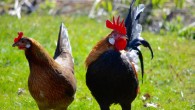
The red junglefowl (Gallus gallus), a species of tropical bird found in south-east Asia, is the primary ancestor of the domestic chicken (Gallus gallus...
A team of paleontologists and mechanical and biomedical engineers has compared CT scans of the fossilized bones of hadrosaurs and other dinosaurs with...
In a new study, an international team of scientists used 22 newly-sequenced genomes from 18 extant species of penguins to reconstruct the history of their...
A new species of crested penguin that lived 3.2 million years ago (Pliocene period) has been identified from multiple exceptionally well-preserved specimens...
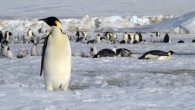
Using images from ESA’s Copernicus Sentinel-2 satellite, a team of researchers from the British Antarctic Survey has spotted 8 new colonies of emperor...
The partial skeletal remains of an enantiornithine bird that lived 99 million years ago (Cretaceous period) have been found preserved in a piece of amber...
A new genus and species of owl that lived 55 million years ago (Eocene epoch) has been identified from a partial skeleton found in Wyoming, the United...
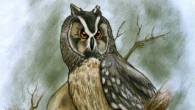
An extinct species of giant owl that lived 40,000 years ago (Pleistocene epoch) and preyed on smaller owls has been identified from fossils found in the...
In a new study, a team of researchers from the United Kingdom, Germany and Argentina deployed high-tech flight-recorders on the world’s heaviest extant...
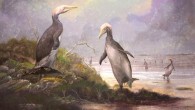
Paleontologists have discovered striking similarities between the fossilized bones of giant penguins that lived 62 million years ago in what is now New...
An international team of archaeologists has uncovered a diminutive carving, depicting a standing bird, at the Paleolithic site of Lingjing in Henan, China....
Lesser flamingos (Phoeniconaias minor), a species of flamingo found in sub-Saharan Africa and India, do not have a breeding season — they breed when...
An international team of ornithologists has described three new species of the bird genus Scytalopus from the Peruvian Andes.
New Scytalopus species from...
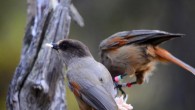
New research on two corvid species, Siberian jays (Perisoreus infaustus) and New Caledonian crows (Corvus moneduloides), shows that extended family life...
A new genus and species of jeholornithiform avialan that lived during the Cretaceous period has been identified from a nearly-complete specimen found in...
Flamingos are well known for their gregarious habits and aggregations in large flocks, but evaluation of the mechanisms behind social grouping remain poorly...
Engraved, painted and embellished with ivory, precious metals and faience fittings, decorated ostrich eggs were traded and exchanged as luxury items around...
A new species of ancient bird has been identified from a nearly complete, three-dimensionally preserved skull and associated bones found in Belgium. A...