Recognizable from the starring role in the film ‘Finding Nemo,’ the clown anemonefish (Amphiprion percula) also shrink in order to avoid social conflict,...
The genus Tyrannosaurus most likely arose in North America, although its direct ancestors migrated over from Asia more than 70 million years ago, according...
The Saharo-Arabian Desert is one of the largest biogeographical barriers on Earth, impeding dispersals between Africa and Eurasia, including movements...
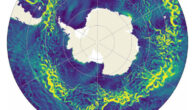
More than four times stronger than the Gulf Stream, the Antarctic Circumpolar Current (ACC) is the world’s strongest ocean current and plays a disproportionate...
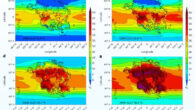
The end-Permian mass extinction, which occurred about 252 million years ago, was the most severe extinction event in the past 540 million years, eliminating...
Using a large assemblage of human fossils from Ice Age Europe, paleoanthropologists have identified a population turnover in Western Europe at 28,000 years...
One-third of Mars’ surface has shallow-buried water, but it is currently too cold for use by life. Proposals to warm Mars using greenhouse gases require...
Fossil and molecular evidence suggests that complex multicellular organisms originated and proliferated during the Neoproterozoic Era (1,000-541 million...
Cold, dense clouds in the interstellar medium of our Milky Way Galaxy are around four-five orders of magnitude denser than their diffuse counterparts....
Archaeologists from Macquarie University and Polish Academy of Science’s Institute of Mediterranean and Oriental Culture have discovered 16 new rock...
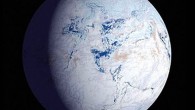
The Sturtian ‘Snowball Earth’ glaciation (717 to 661 million years ago) is regarded as the most extreme interval of icehouse climate in Earth’s history....
Gigantopithecus blacki, the largest ever primate and one of the largest species of the southeast Asian megafauna, persisted in China from about 2 million...
Populations genetically related to present-day Europeans first appeared in Europe at some point after 38,000-40,000 years ago, following a cold period...
Around 12,800 years ago, Earth collided with fragments of a disintegrating comet, triggering Younger Dryas climate change; this event created environmental...
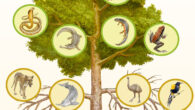
Mass extinctions during the past 500 million years rapidly removed branches from the tree of life and required millions of years for evolution to generate...
Today, there are more than 8 billion human beings on the planet. Our species dominate Earth’s landscapes, and our activities are driving large numbers...
In a study sample of 380,000 environmentally oriented users, nearly 47.5% became inactive on Twitter (recently renamed X) after it was sold in October...
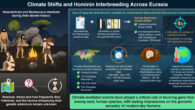
Looking at habitat overlap for Neanderthals and Denisovans, Pusan National University researcher Jiaoyang Ruan and colleagues found patterns of interbreeding...
The newly-identified species of basilosaurid whale has been named Tutcetus rayanensis after the ancient Egyptian pharaoh Tutankhamun. This new species...