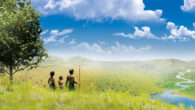
Paleontologists have examined a large assemblage of dinosaur tracks and fossilized plants from the Nanushuk Formation, which crops out over much of the...
Geoscientists from Australia and France have used the geological record of Earth’s deep oceans to discover a connection between the orbits of our home...
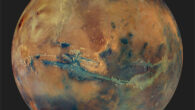
The history of water on Mars is a puzzle that is of interest to planetary scientists as well as the general public. The Red Planet currently has water...
The Sturtian ‘Snowball Earth’ glaciation (717 to 661 million years ago) is regarded as the most extreme interval of icehouse climate in Earth’s history....
Gigantopithecus blacki, the largest ever primate and one of the largest species of the southeast Asian megafauna, persisted in China from about 2 million...
Frostquakes are seismic events with frequencies of about 10-20 Hz and waveforms like those of tectonic events. They potentially can damage infrastructures...
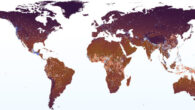
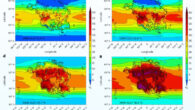
Sounds of human languages can be affected by various factors of the natural environment. One such factor is the mean annual temperature. In new research,...
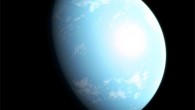
Two new papers in the Astronomical Journal show that in some multiplanet systems, giant planets tend to kick their smaller neighbors out of orbit and wreak...
About 66 million years ago, a massive asteroid crashed into Earth near the site of the small town of Chicxulub in what is now Mexico. The impact eradicated...
Populations genetically related to present-day Europeans first appeared in Europe at some point after 38,000-40,000 years ago, following a cold period...
Around 12,800 years ago, Earth collided with fragments of a disintegrating comet, triggering Younger Dryas climate change; this event created environmental...
Our species, Homo sapiens, dispersed from Africa into Eurasia multiple times in the Middle and Late Pleistocene. According to new research led by Shantou...
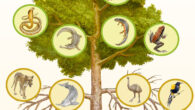
Mass extinctions during the past 500 million years rapidly removed branches from the tree of life and required millions of years for evolution to generate...
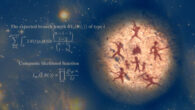
Today, there are more than 8 billion human beings on the planet. Our species dominate Earth’s landscapes, and our activities are driving large numbers...
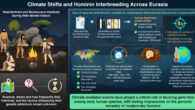
Looking at habitat overlap for Neanderthals and Denisovans, Pusan National University researcher Jiaoyang Ruan and colleagues found patterns of interbreeding...
A new genus and species of eutherian mammal has been described from a handful of tiny teeth found in the Prince Creek Formation in northern Alaska, the...
New paleoclimate evidence shows that around 1.1 million years ago, the southern European climate cooled significantly and caused an extinction of archaic...
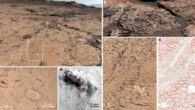
New observations of mud cracks made by NASA’s Curiosity rover show that high-frequency, wet-dry cycling occurred in early Martian surface environments,...
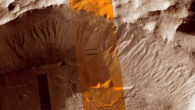
Some steep slopes on Mars have gullies with morphologies suggesting that they were formed by a liquid. However, the planet’s current climate is not conducive...