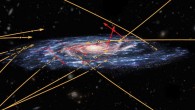
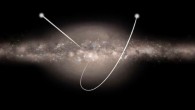
Astronomers using data from ESA’s star mapping Gaia mission to look for hypervelocity stars being kicked out of our Milky Way Galaxy were surprised to...
In October 2017, a fast moving, cigar-shaped comet of extrasolar origin was discovered close to the Earth with the Pan-STARRS1 telescope in Hawai’i....
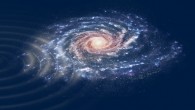
Astronomers analyzing data from the second release of ESA’s star mapping mission Gaia have shown that our Milky Way Galaxy is still enduring the effects...
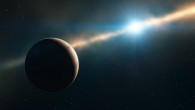
A duo of astronomers at Leiden University in the Netherlands has deduced the mass of Beta Pictoris b from the motion of its parent star, which lies 63...
A research team led by Harvard University astronomer Li Zeng has shown that water is likely to be a major component of extrasolar planets which are between...
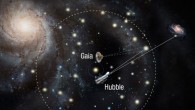
Astronomers have used the NASA/ESA Hubble Space Telescope and ESA’s Gaia space observatory to make the most precise measurements of the expansion rate...
An unknown dwarf galaxy, dubbed ‘Sausage’ galaxy, smashed into our own Milky Way Galaxy around 8 to 10 billion years ago, a team of astronomers suggests....
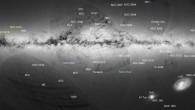
ESA’s Gaia mission has released the largest catalogue ever of Milky Way stars. It includes the positions on the sky for approximately 1.7 billion stars,...
The upcoming encounter of NASA’s New Horizons spacecraft with 2014 MU69 will be an important and rare opportunity for close-up study of a Kuiper Belt...
Based on the combination of data taken 12 years apart by the NASA/ESA Hubble Space Telescope and ESA’s Gaia mission, astronomers have pinned down for...
At a distance of 420 million light-years, the recently-discovered SN 2017egm is the nearest Type I superluminous supernova to date, and the first near...
On its way to assembling the most detailed 3D map ever made of our Galaxy, ESA’s Gaia spacecraft has pinned down the precise position on the sky and...
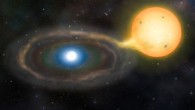
Using ESA’s Gaia satellite, a large multinational group of astronomers has discovered a unique binary star system: the first known such binary where...