Otodus megalodon, a megatooth shark that lived between 23 and 3.6 million years ago, was not a fast swimmer, but it had a mega-appetite explaining its...
Scientists from the Australian Museum Research Institute, the University of Sydney and the Museum and Art Gallery of the Northern Territory have described...
Spiranthes hachijoensis occurs in Kyushu, Shikoku, Chubu, and Kanto districts of Japan.
Spiranthes hachijoensis in Ena-shi, Japan: (a) inflorescence; (b)...
Biologists have isolated a new type of multicellular bacterium, named Jeongeupia sacculi HS-3, from an underground stream in northern Kyushu Island, Japan....
Scientifically named Stylobates calcifer, the new sea anemone species lives in a symbiotic relationship with a species of hermit crab called Pagurodofleinia...
A new genus and species of therizinosaurid dinosaur that lived during the Cretaceous period has been identified from the fossilized remains unearthed on...
Marine biologists have described a third species of branching syllid worm — and the second within the genus Ramisyllis — living inside an undescribed...
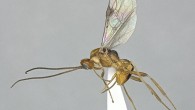
Meteorus stellatus inhabits primary forests of the Okinawa-hontô and Amami-ôshima Islands, subtropical Japan.
Meteorus stellatus. Image credit: S. Fujie.
“Parasitoid...
A team of researchers from the Okinawa Institute of Science and Technology Graduate University and University College London has decoded the genome of...
Scientists have isolated a new orthonairovirus from two patients showing acute febrile illness with thrombocytopenia and leukopenia after tick bite in...
The Japanese archipelago, which has been occupied by humans for at least 38,000 years, underwent rapid transformations in the past 3,000 years, first from...
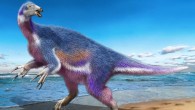
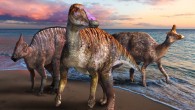
Yamatosaurus izanagii roamed our planet 71.8 million years ago during the Late Cretaceous epoch.
This artist’s illustration of Yamatosaurus izanagii...
A team of biologists from Japan has discovered a new species of the genus Scolopendra living in the forests of the Ryukyu Archipelago and Taiwan.
Scolopendra...
A new species of nostoceratid ammonite that lived during the Coniacian stage of the Cretaceous period has been identified from fossils found in Japan.
Life...
Paleolithic people deliberately crossed the challenging ocean to migrate to the Ryukyu Islands of southwestern Japan, even though the islands would not...
An international team of researchers has discovered microbial life, in particular bacterial vegetative cells, in up to 1.2-km-deep and up to 120 degrees...
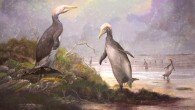
Paleontologists have discovered striking similarities between the fossilized bones of giant penguins that lived 62 million years ago in what is now New...
Marine biologists have discovered a new species of the shark genus Squalus in the tropical waters off southern Japan.
The Shirai’s spurdog (Squalus shiraii):...
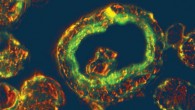
An international team of researchers has found bacterial communities within microscopic spheroidal aggregates of dolomite, oil and water found in sheets...