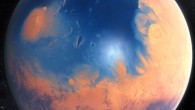
An analysis of chromium isotopes in Martian meteorites suggests that approximately 4.5 billion years ago, there was enough water for the entire planet...
Lonsdaleite, a rare hexagonal form of diamond found in ureilite meteorites, formed shortly after an inner solar system dwarf planet collided with a large...
Earth is the only planet known to have continents, although how they formed and evolved is unclear.
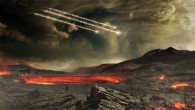
An artist’s concept of meteors impacting the ancient...
New research shows that the Martian meteorite Northwest Africa (NWA) 7034, known more commonly as ‘Black Beauty,’ was ejected between 5 and 10 milliom...
When a space body enters Earth’s atmosphere, its surface is exposed to high pressure and temperatures. The airflow tears off small droplets from the...
Planetary scientists from the ETH Zürich and elsewhere have determined palladium-silver (Pd-Ag) and platinum (Pt) isotope compositions of 13 iron meteorites...
Using neutron and X-ray tomography, a team of planetary researchers from Lund University and elsewhere examined a section of Miller Range (MIL) 03346,...
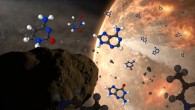
Using state-of-the-art analytical techniques, researchers have detected diverse suites of nucleobases — including canonical base pairs (e.g., adenine-uracil,...
Archaeologists have found meteorites, microspherules, iridium and platinum anomalies, and burned charcoal-rich habitation surfaces at 11 archaeological...
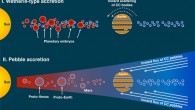
Two fundamentally different processes of rocky planet formation exist, but it is unclear which one built the Earth and other terrestrial solar system planets....
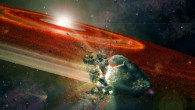
Around 4.567 billion years ago, our Solar System harbored a gap within the protoplanetary disk, near the location where the main asteroid belt resides...
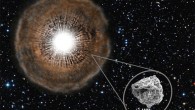
An international team of scientists has analyzed a diverse set of presolar grains with the goal of realizing their true stellar origins.
Palmerini et al....
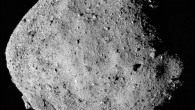
Planetary researchers have discovered an inverse correlation between the local abundance of fine-grain material and the porosity of rocks on the carbonaceous...
The habitability of Mars is limited by its small size, according to new research by Washington University in St. Louis planetary scientists.
This artist’s...
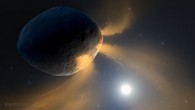
The 5.8-km-wide (3.6-mile) near-Earth asteroid Phaethon, which is the source of the annual Geminid meteor shower, brightens as it gets close to the Sun....
In 2011, planetary researchers using samples of the solar wind collected by NASA’s Genesis spacecraft found that solar system planetary bodies have a...
Asteroid material in chondritic Vigarano class alteration type 3 (CV3) meteorites provide a good record of complex chemistry present when or before our...
About 66 million years ago, a 10-km- (6.2-mile) wide asteroid crashed into Earth near the site of the small town of Chicxulub in what is now Mexico. While...
Dr. Peter Jenniskens of the SETI Institute and NASA’s Ames Research Center and his colleagues say they can detect meteor showers from the debris in the...