A team of archaeologists from Germany has discovered a submerged Stone Age megastructure in the Western Baltic Sea at a water depth of about 21 m. The...
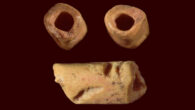
Archaeologists have discovered an ancient tube-shaped bead made of hare bone at the La Prele Mammoth site in Wyoming, the United States. This is the oldest...
Homo sapiens associated with the Lincombian-Ranisian-Jerzmanowician culture were present in central and northwestern Europe long before the extinction...
Archaeologists from the Senckenberg Centre for Human Evolution and Palaeoenvironment at the University of Tübingen have analyzed the ancient animal remains...
Paleoanthropologists have reconstructed the face of a Neanderthal man whose 56,000-year-old remains were found at La Chapelle-aux-Saints in south-central...
Archaeologists in Belgium have demonstrated that spearthrowers were used for launching projectiles armed with tanged flint points at the Early Upper Paleolithic...
Populations genetically related to present-day Europeans first appeared in Europe at some point after 38,000-40,000 years ago, following a cold period...
Around 12,800 years ago, Earth collided with fragments of a disintegrating comet, triggering Younger Dryas climate change; this event created environmental...
Anthropologists in Greece have used facial reconstruction techniques to show how Homo heidelbergensis, a poorly understood relative of Neanderthals that...
During the Upper Paleolithic, lions become an important theme in Paleolithic art and are more frequent in anthropogenic faunal assemblages. However, the...
In new research, scientists from the University of Leeds and elsewhere measured radiocarbon levels in ancient trees preserved within the eroded banks of...
Our species, Homo sapiens, dispersed from Africa into Eurasia multiple times in the Middle and Late Pleistocene. According to new research led by Shantou...
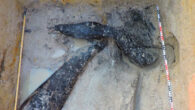
Archaeologists have found an ancient wooden structure at the archaeological site of Kalambo Falls in Zambia. This structure — dated to about 476,000...
New evidence from three tracksites on South Africa’s Cape coast suggests that early humans may have worn footwear while traversing dune surfaces during...
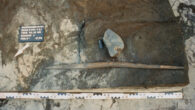
An analysis of a 300,000-year-old double-pointed wooden stick from the Middle Pleistocene site of Schöningen, Germany, shows it was scraped, seasoned...
Non-figurative markings on the walls of La Roche-Cotard cave in France are the oldest known engravings made by our sister species.
The 57,000-year-old...
Archaeologists have found seven flutes made of perforated bird bones at the Natufian site of Eynan-Mallaha in northern Israel. These instruments were intentionally...