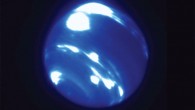
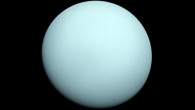
An unusually bright storm system nearly the size of Earth has been spotted in the atmosphere of Neptune, baffling researchers because it is located near...
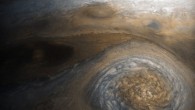
A stunning new image of Jupiter captured by NASA’s Juno robotic orbiter shows a huge storm called the North North Temperate Little Red Spot 1 (NN-LRS-1),...
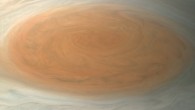
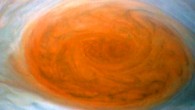
NASA’s Juno spacecraft took this stunning photo of Jupiter’s most distinctive feature, its Great Red Spot, from orbit.
This true color image of Jupiter’s...
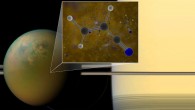
Researchers using archival data from the ALMA (Atacama Large Millimeter/submillimeter Array) have found evidence that molecules of vinyl cyanide, also...
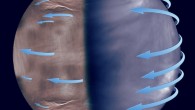
A team of researchers led by JAXA’s Institute of Space and Astronautical Science has discovered unexpected patterns of slow motion and stationary waves...
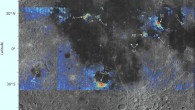
Ancient volcanic deposits distributed across the surface of the Moon contain unexpectedly high amounts of water compared with surrounding terrains, according...
New research from Monash University and the University of Queensland has added a new dimension to understanding life on the Red Planet with the discovery...
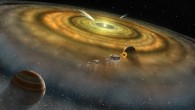
Water on Earth, Mars and everywhere within the inner Solar System can be traced back to the rapid waist-expanding growth of Jupiter and Saturn, which knocked...
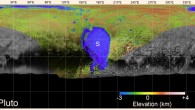
On July 14, 2015, NASA’s New Horizons spacecraft made its historic flight through the Pluto system. On the two-year anniversary of the flyby, the New...
Water-dwelling, eight-legged, segmented micro-animals called tardigrades will survive the risk of extinction from all astrophysical catastrophes, and be...
NASA’s Juno spacecraft has provided planetary researchers the first close-up views of Jupiter’s mysterious, roiling storm called the Great Red Spot.
This...
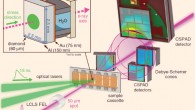
A Stanford-led research team has captured the freezing of water, molecule-by-molecule, into a super-dense, exotic form of ice called ice VII. The results...
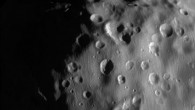
NASA’s Cassini robotic orbiter captured this incredible view of Epimetheus, an inner satellite of Saturn, during a flyby on February 21, 2017. The flyby...
New research has found that most waves on Titan’s seas of liquid hydrocarbons are diminutive, reaching only about 1 cm (0.4 inches) high and 20 cm (8...
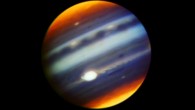
High-resolution imaging of Jupiter and its Great Red Spot by the Subaru Telescope and the Gemini North telescope, both on Hawaii’s Mauna Kea peak, is...
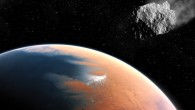
Mars experienced a single colossal impact during its first 130 million years, the equivalent to the largest body in the today’s asteroid belt slamming...
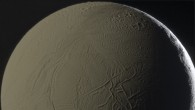
Using the IRAM radio telescope, astronomers have observed an extended gas cloud around Saturn’s moon Enceladus and detected the signature of the organic...
A new study published in the Journal of Geophysical Research: Space Physics suggests that the magnetosphere of the ice giant Uranus gets flipped on and...
A team of solar physicists from the Bay Area Environmental Research Institute, University of Oslo and Lockheed Martin Solar and Astrophysics Laboratory...