Astronomy News

Jun 19, 2017 by News Staff

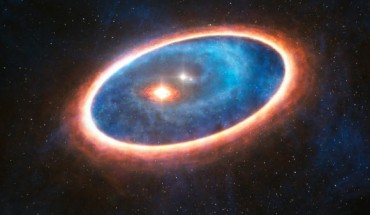
According to a team of astronomers from Harvard University and the University of California, Berkeley, low-mass stars are always born with a companion, but many, like the Sun, split up. This artist’s impression shows the dust and gas around a binary star system. Image credit: ESO / L. Calcada. Many stars have companions, including the triple star system of Alpha Centauri, just 4.3 light-years away. Scientists have long sought an explanation. Are...

Jun 19, 2017 by News Staff

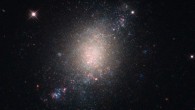
The NASA/ESA Hubble Space Telescope has taken a picture of the galaxy LEDA 16643, which is found in the constellation Lepus. This image, taken with Hubble’s...

Jun 16, 2017 by News Staff

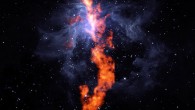
Dr. Rachel Friesen of the University of Toronto and colleagues have captured a detailed image of a 50-light-year-long filament of star-forming gas in the...

Jun 14, 2017 by News Staff

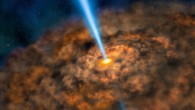
Using observations from NASA’s Stratospheric Observatory for Infrared Astronomy (SOFIA), a Boeing 747SP jetliner modified to carry a 100-inch telescope,...

Jun 14, 2017 by News Staff

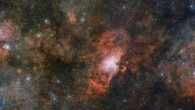
Two spectacular and famous nebulae — the Eagle Nebula and the Omega Nebula — share the stage with their lesser-known neighbor, a glowing cloud...

Jun 13, 2017 by News Staff

A new study based on observations with the NASA/ESA Hubble Space Telescope has shown that so-called brightest cluster galaxies (BCGs) — the very...

Jun 12, 2017 by News Staff

A team of astronomers has determined how the gas flow from a massive infant star is launched. The researchers used the Atacama Large Millimeter/submillimeter...

Jun 12, 2017 by News Staff

The NASA/ESA Hubble Space Telescope observed the nearby white dwarf star Stein 2051B as it passed in front of a background star. During the close alignment,...

Jun 11, 2017 by Natali Anderson

Dr. Jessie Christiansen, a staff scientist at the NASA Exoplanet Science Institute, and colleagues have discovered a ‘super-Earth’ exoplanet orbiting...

Jun 9, 2017 by News Staff

A new study by the University of Wisconsin-Madison supports the idea that our Milky Way Galaxy and its neighbors exist in one of the holes, or voids, of...

Jun 9, 2017 by News Staff

Using numerical simulations to identify planets stable for millions of years, a team of researchers concluded that six of the seven roughly Earth-sized...

Jun 8, 2017 by News Staff

Astronomers have harnessed the power the Atacama Large Millimeter/submillimeter Array (ALMA) in Chile to detect methyl isocyanate — a chemical building...

Jun 7, 2017 by News Staff

The first observation of displacement of a star due to bending of its light by another celestial body other than our Sun is revealed in new research. This...

Jun 6, 2017 by News Staff

Astronomers using the Atacama Large Millimeter/submillimeter Array (ALMA) may have solved the mystery of the coldest known object in the cosmos —...

Jun 6, 2017 by News Staff

A newly-discovered Jupiter-like exoplanet called KELT-9b is only 2,000 degrees Fahrenheit (927 degrees Celsius, or 1,200 degrees Kelvin) cooler than our...

Jun 5, 2017 by Natali Anderson

Astronomers have used the NASA/ESA Hubble Space Telescope to track the two components of Luhman 16AB, the third closest system to the Solar System. This...

Jun 3, 2017 by Sergio Prostak

Professional and citizen astronomers with the NASA-funded ‘Backyard Worlds: Planet 9’ project have made their first significant discovery: a new brown...

Jun 1, 2017 by Sergio Prostak

Astronomers have discovered a super-Earth exoplanet orbiting the red dwarf star Gliese 625. This artist’s concept depicts a super-Earth-size exoplanet....

May 31, 2017 by Natali Anderson

Astronomers have identified that the light from PDS 110 is regularly blocked by a large object — and they predict that these eclipses are caused...

May 30, 2017 by News Staff

Australian National University astrophysicist Dr. Roland Crocker and his colleagues from Europe, New Zealand, Australia and the United States have shown...