Astronomy News

Nov 4, 2014 by News Staff

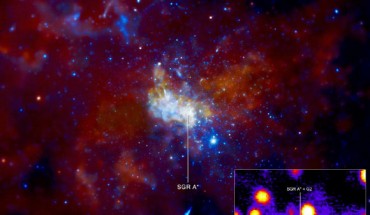
A dusty red object at the heart of our Milky Way Galaxy called G2 is a pair of binary stars that merged together, according to a team of researchers led by Dr Gunther Witzel from the University of California Los Angeles. This image shows the supermassive black hole Sgr A* and the region around it. The inset shows Sgr A* and G2. Image credit: NASA / CXC / MIT / F.K. Baganoff et al. / E. Slawik / G. Witzel et al. Since 2002, astronomers have been puzzled...

Nov 4, 2014 by News Staff

Astronomers using ESO’s Very Large Telescope Interferometer (VLTI) have discovered exozodiacal light – starlight reflected from dust created as...

Nov 3, 2014 by News Staff

Professional astronomers and volunteers from the Planet Hunters citizens science program have discovered a low-mass, low-density exoplanet circling a Sun-like...

Oct 31, 2014 by News Staff

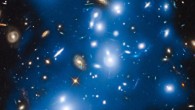
Astronomers using NASA’s Hubble Space Telescope to probe a galactic supercluster known as Abell 2744 have found forensic evidence of galaxies that were...

Oct 30, 2014 by News Staff

For the first time, astronomers have detected a streamer of gas flowing from a massive outer disc of planet-forming material toward the inner, smaller...

Oct 29, 2014 by News Staff

In April 2014, astronomers using NASA’s Hubble Space Telescope obtained a remarkable new view of Jupiter as they tracked changes in the Great Red...

Oct 28, 2014 by News Staff

For the first time, scientists have captured images of a nova during its early fireball stage – when it ejects material, and gases expand and cool....

Oct 23, 2014 by News Staff

A multinational team of astronomers studying the chemical make-up of the atmosphere on Saturn’s moon Titan has revealed large zones of two organic...

Oct 22, 2014 by News Staff

French astronomers using the HARPS instrument on the ESO 3.6-m telescope at the La Silla Observatory in Chile have discovered nearly 500 comets around...

Oct 21, 2014 by News Staff

Astronomers using the Atacama Large Millimeter/submillimeter Array have detected an unusual carbon-based molecule called iso-propyl cyanide (i-C3H7CN)...

Oct 16, 2014 by News Staff

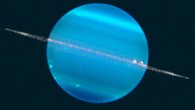
An ice giant that resembles our Solar System’s Uranus has been discovered about 25,000 light-years from Earth, by a multinational team of scientists...

Oct 11, 2014 by News Staff

In an effort to better understand how the Universe evolved as the first stars were formed, U.S. astronomers led by Dr Sanchayeeta Borthakur of Johns Hopkins...

Oct 11, 2014 by News Staff

An international group of scientists using NASA’s Hubble Space Telescope has produced a global weather map of a hot-Jupiter exoplanet called WASP-43b,...

Oct 9, 2014 by News Staff

An international team of astronomers, led Dr Matteo Bachetti of the University of Toulouse in France, has detected what they say is the most powerful pulsar...

Sep 24, 2014 by News Staff

A team of astronomers from the United States, Chile and Europe has detected water vapor in the atmosphere of a Neptune-sized extrasolar planet known as...

Sep 20, 2014 by News Staff

Astronomers conducting a broad survey of galaxies called Galaxy and Mass Assembly (GAMA) have found that the Universe’s most massive galaxies gain weight...

Sep 18, 2014 by News Staff

A multinational group of astronomers led by Dr Anil Seth of the University of Utah has discovered a supermassive black hole at the center of an ultra-compact...

Sep 16, 2014 by News Staff

Astronomers using data from the Isaac Newton Telescope on La Palma in the Canary Islands have assembled a catalogue of the visible part of the northern...

Sep 11, 2014 by News Staff

Astronomers using the Cosmic Origins Spectrograph and Wide-Field Camera 3 aboard NASA’s Hubble Space Telescope have finally discovered a companion...

Sep 11, 2014 by News Staff

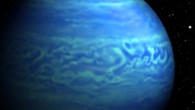
Astronomers led by Dr Jacqueline Faherty from Carnegie Institution of Washington and American Museum of Natural History have discovered evidence of water...