Featured News

Aug 24, 2016 by James Romero

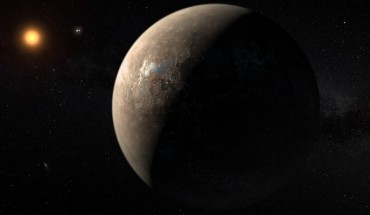
A planet described as the ‘single most promising exoplanet discovered to date in terms of habitability’ and a ‘natural location where our civilization could aspire to move to’, has been found orbiting the closest star to our Sun. This artist’s impression shows Proxima b orbiting Proxima Centauri, which at only 4.23 light-years is the closest star to our Solar System. The double star Alpha Centauri AB also appears in the image between the...
Aug 23, 2016 by News Staff

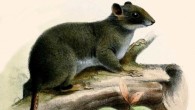
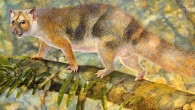
A new species of marsupial lion that lived approximately 18 million years ago has been identified from fossils found in Australia. Reconstruction of Microleo...

Aug 22, 2016 by News Staff

Certain beetles are known to pollinate plants. New fossil evidence from Mexican and Dominican fossilized amber indicates that they were doing so 20 million...

Aug 22, 2016 by Natali Anderson

According to a team of botanists and dendrochronologists from the University of Arizona, Stockholm University and the University of Mainz, a pine growing...

Aug 19, 2016 by James Romero

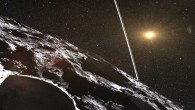
Our gas giants strip the icy surface off minor planets to form miniature versions of Saturn’s famous rings throughout the outer solar system, according...

Aug 18, 2016 by Enrico de Lazaro

Humans living Teotihuacan, a sacred pre-Columbian city that flourished between 1 CE and 600 CE and was once the largest in the Americas, may have bred...

Aug 17, 2016 by Natali Anderson

For the first time, scientists have sequenced and analyzed the nuclear and mitochondrial DNA of the Cameroon scaly-tail (Zenkerella insignis), one of Africa’s...

Aug 17, 2016 by News Staff

The Preface of the Venus Table of the Dresden Codex, first panel on left, and the first three pages of the Table. Image credit: University of California,...

Aug 16, 2016 by News Staff

Recent findings by a team of experimental nuclear physicists in Hungary indicating the possible discovery of a new subatomic particle may be evidence of...

Aug 15, 2016 by News Staff

A team of scientists led by Dr. Ole Andreassen of the University of Oslo in Norway and the University of California, San Diego, has found evidence for...

Aug 12, 2016 by James Romero

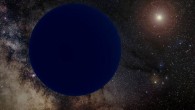
A Cornell University Professor’s recalculation of models linking a proposed 9th solar system planet to a slant in the orbital plane around our Sun could...

Aug 11, 2016 by Natali Anderson

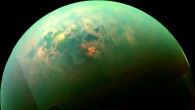
Liquid methane-filled canyons hundreds to thousands of feet deep etch the surface of Saturn’s largest moon, according to researchers with NASA’s Cassini...

Aug 10, 2016 by Enrico de Lazaro

A team of scientists at the University of Maryland has discovered a beautiful, swirling flame phenomenon, the ‘blue whirl,’ which evolves from a fire...

Aug 10, 2016 by News Staff

An international team of researchers from Singapore and the United Kingdom has identified an enzyme that regulates the production of sperm and egg cells...

Aug 9, 2016 by News Staff

New research led by University of Victoria’s April Nowell reveals surprisingly sophisticated adaptations by early humans living 250,000 years ago in...

Aug 8, 2016 by Enrico de Lazaro

27-million-year-old fossil of newly-discovered toothed whale species provides clues about evolution of high-frequency hearing. Echovenator sandersi produces...

Aug 5, 2016 by News Staff

According to a team of physicists at Imperial College London (ICL), UK, it is possible to create a new form of light by binding light to a single electron,...

Aug 4, 2016 by Enrico de Lazaro

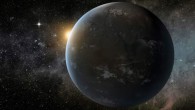
A team of astronomers from the United States and France has pinpointed which of 4,270 exoplanets discovered by NASA’s Kepler mission are most likely...

Aug 4, 2016 by Enrico de Lazaro

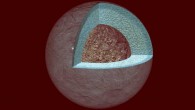
Using data from NASA’s Dawn spacecraft about Ceres’ gravity and topography, mission scientists have found that the dwarf planet is ‘differentiated,’...

Aug 3, 2016 by News Staff

According to an international team of scientists led by Dr. Nicholas Mundy at the University of Cambridge, a gene for red color vision that originated...