The newly-identified gas cloud, dubbed G2t, follows nearly the same orbit as two known clouds, suggesting they were all expelled by a pair of massive stars...
With the record-setting image from the Atacama Large Millimeter/submillimeter Array (ALMA), astronomers have mapped the molecular heart of our Milky Way...
Using archival data from NASA’s NEOWISE mission along with data from other space and ground-based observatories, astronomers identified the clearest...
For decades, the motions of stars near the center of our Milky Way Galaxy have been treated as some of the clearest evidence for a supermassive black hole....
Physicists at the University of Massachusetts Amherst argue that an ultra-high-energy neutrino detected by the KM3NeT experiment could be the signature...
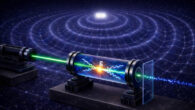
Stevens Institute of Technology physicist Igor Pikovski and colleagues are developing the first experiment designed to capture individual gravitons —...
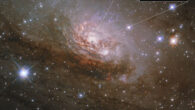
Astronomers using NASA’s James Webb Space Telescope have captured the most detailed infrared view yet into the center of the Circinus Galaxy, one of...
New observations of the young cluster SPT2349-56 with the Atacama Large Millimeter/submillimeter Array (ALMA) have revealed unexpectedly scorching intracluster...
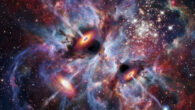
A rare trio of merging galaxies called J121/1219+1035 hosts three actively feeding, radio-bright supermassive black holes, according to a team of U.S....
Using data gathered by a suite of space- and ground-based telescopes, astronomers have discovered AT 2024wpp, the most luminous fast blue optical transient...
Astronomers using the NASA/ESA/CSA James Webb Space Telescope have discovered chemical fingerprints of primordial stars weighing between 1,000 and 10,000...
Using ESA’s XMM-Newton and the X-Ray Imaging and Spectroscopy Mission (XRISM), a JAXA-led mission with ESA and NASA participation, astronomer have observed...
Using data from the RadioAstron satellite, astronomers have produced a radio image of two supermassive black holes at the center of the distant quasar...
The newly-discovered supermassive black hole sits in the center of a ‘little red dot’ galaxy called CAPERS-LRD-z9 and is seen just 500 million years...
A supermassive black hole in the center of the radio quasar RACS J032021.44-352104.1 (RACS J0320-35 for short) is growing at one of the fastest rates ever...