The 2018 eruption of Kīlauea volcano in Hawaii was likely initiated by prolonged, and at times extreme, rainfall in the months leading up to the event,...
Ancient Australia’s super-sized animals, the megafauna, became extinct about 42,000 years ago, but the role of humans in their demise has been debated...
The Akkadian Empire, the first united empire in Mesopotamia, was established around 2300 BCE and abruptly collapsed two centuries later. According to a...
There’s always a lot of extraterrestrial dust floating down to Earth, but this dust is normally only a tiny fraction of the other dust in our atmosphere...
Paleontologists largely agree that the Chicxulub asteroid impact, possibly coupled with intense volcanic activity in India’s Deccan Traps, wiped out...
Some 252 million years ago, intense volcanic activity belched massive volumes of greenhouse gasses into the atmosphere and triggered rapid changes to the...
It is no secret that climate change and environmental negligence have been worsened by human activity and accelerated industrialization over the past century,...
New evidence indicates the primary cause of the extinction of one of Australia’s top predators, the marsupial lion (Thylacoleo carnifex), around 40,000...
Energy generation by wind and solar farms could reduce carbon emissions and thus mitigate anthropogenic climate change. A new climate-modeling study, published...
Snakebites, contrary to public opinion, increase after rainy years, not drought, according to a new study that examined two decades of rattlesnake bite...
The transition from Neanderthals to modern humans in Europe occurred during a period of recurring cold climate cycles. In a new study, a team of researchers...
There are multiple theories as to what caused the collapse of the Classic Maya civilization, such as invasion, war, environmental degradation, etc. In...
In one of the largest studies of its kind, an international team of researchers conducted organic residue analysis of almost 800 ceramic vessels from 46...
As the population of a technologically advanced civilization grows, it uses more and more of its planet’s resources. By consuming the resources, the...
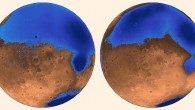
A team of geophysicists at the University of California, Berkeley, proposes that Martian oceans originated several hundred million years earlier than thought,...
A groundbreaking new technique for studying lake sediments can tell scientists more about the frequency and intensity of past and future insect epidemics,...
A team of researchers from Lancaster University and the Universities of Edinburgh and Leeds, UK, forecasts a 15% drop in the average number of lightning...
A Yale University-led study suggests that abrupt shifts in climate caused by massive volcanic eruptions helped to trigger poorly understood revolts —...