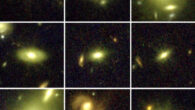
Astronomers using the NASA/ESA/CSA James Webb Space Telescope have revealed a surprisingly large population of faint, low-mass stars in distant galaxies,...
New simulations suggest supernova explosions of the Universe’s first stars scattered the ingredients for rocky planets only 100 million years after the...
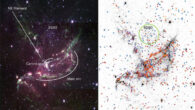
The candidate planetary system, detected with the microlensing method, is thought to move at least 540 km per second (1.2 million mph).
An artist’s impression...
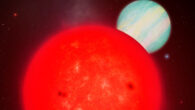
Very-low-mass stars host orbiting rocky exoplanets more frequently than other types of stars. The compositions of those planets are largely unknown but...
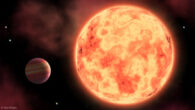
Current theories predict that low-mass stars should rarely host planets with masses exceeding that of Neptune (17 Earth masses).
An artist’s impression...
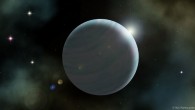
Using spectropolarimetric data gathered by various telescopes around the globe, astronomers from the University of Amsterdam and elsewhere have identified...
Gas giants, like other planets, form from protoplanetary disks of material around protostars. According to core accretion theory, they first form a core...