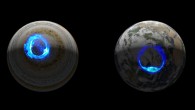
Dawn storms consist of short-lived but intense brightening and broadening of Jupiter’s main auroral oval near where the atmosphere emerges from darkness...
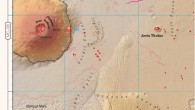
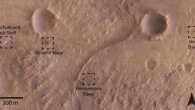
The 84-page atlas of Mars, currently available in English, Hungarian and Czech, was developed as a part of a public outreach project supported by the Europlanet...
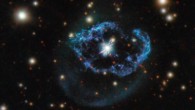
Astronomers using the NASA/ESA Hubble Space Telescope and the 1.8-m Pan-STARRS1 telescope have captured a detailed image of the unusual planetary nebula...
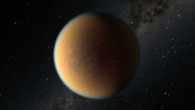
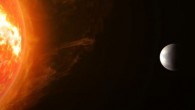
Using the NASA/ESA Hubble Space Telescope, astronomers have found evidence of volcanic activity reforming the atmosphere of Gliese 1132b, a rocky exoplanet...
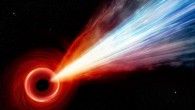
The source of the 160,000-light-year-long jet of particles is PSO J352.4034-15.3373 (PJ352-15 for short), a rapidly growing supermassive black hole, or...
The zodiacal light is sunlight reflected by interplanetary dust in the inner Solar System. Variations in the zodiacal light with ecliptic latitude reveal...
Five sub-Neptunes and one super-Earth exoplanet orbit a moderately bright K-type star called K2-138.
An artist’s impression of the six-planet system...
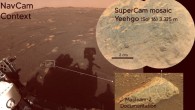
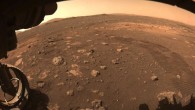
On March 4, 2021, NASA’s Perseverance rover covered 6.5 m (21.3 feet) across the Martian landscape.
This image was captured while Perseverance drove...
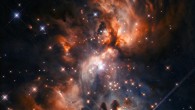
The NASA/ESA Hubble Space Telescope has captured a striking new photo of the star-forming region AFGL 5180.
This Hubble image shows AFGL 5180, a stellar...
Astronomers using the NASA/ESA Hubble Space Telescope have discovered the reason for the dimming of a red hypergiant star called VY Canis Majoris.
This...
Astronomers from the CARMENES (Calar Alto high-Resolution search for M dwarfs with Exoearths with Near-infrared and optical Échelle Spectrographs) consortium...
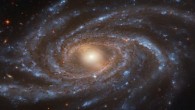
The NASA/ESA Hubble Space Telescope has produced this beautiful image of the barred spiral galaxy NGC 2336.
This Hubble image shows NGC 2336, a barred...
Supernova 1987A (SN 1987A) was first observed on February 23, 1987 in a nearby dwarf galaxy, the Large Magellanic Cloud, some 164,000 light-years away....
New images of NASA’s Perseverance rover, along with its parachute, heat shield and descent stage, were captured by the CaSSIS camera aboard ESA’s Trace...
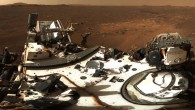
The 360-degree panorama (high-resolution .tif image) was created from 142 individual images taken on February 21, 2021 (Sol 3) using Mastcam-Z, a mast-mounted...
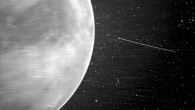
The new image was taken by the Wide-field Imager for Parker Solar Probe (WISPR) during the close flyby of the second planet from the Sun on July 11, 2020.
When...
The majority of supermassive black holes lie dormant and starved of fuel; these hidden giants can be temporarily illuminated when an unlucky star passes...
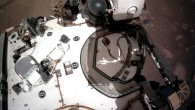
NASA’s Mars 2020 Perseverance mission captured footage of its rover landing in Jezero Crater on February 18, 2021. The footage was captured by several...