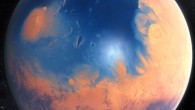
Water may emerge in connection with the formation of terrestrial planets, according to a new analysis of a Martian meteorite called North West Africa (NWA)...
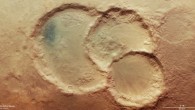
ESA’s Mars Express orbiter has spotted three overlapping craters in Noachis Terra, an extensive landmass in the southern hemisphere of Mars.
This image...
NASA’s Juno spacecraft has been in orbit around Jupiter since 2016. One of its instruments is the ultraviolet spectrograph (UVS), which is primarily...
Using data gathered by NASA’s Transiting Exoplanet Survey Satellite (TESS) and ESA’s Gaia satellite, a team of U.S. astronomers has identified 1,004...
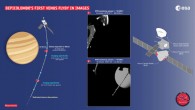
BepiColombo, a joint endeavor between the European Space Agency (ESA) and the Japan Aerospace Exploration Agency (JAXA), successfully completed its first...
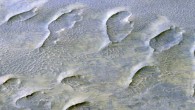
Planetary researchers have mapped and characterized ancient sand dune fields in the canyons of Valles Marineris on Mars. Their discovery offers new insights...
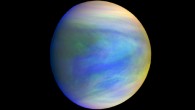
If the atmosphere of Venus was at any point thin and similar to Earth’s, then ancient asteroid impacts transferred potentially detectable amounts of...
Early in the formation of Jupiter as a planet, it moved closer to and then away from the Sun due to interactions with the planetary disk of the young Solar...
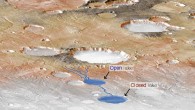
Using new radar data from ESA’s Mars Express spacecraft, researchers have detected three reservoirs of liquid water trapped below the south polar cap...
A significant portion of some of the oldest terrain on Venus, known as tesserae, has striations consistent with layering, according to new research led...
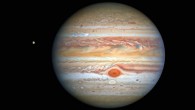
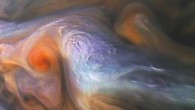
Two new photos, taken with the NASA/ESA Hubble Space Telescope, show Jupiter with its turbulent atmosphere and giant storms. One of the images also features...
Using data from the PACS photometer onboard ESA’s Herschel Space Observatory, astronomers have found that thermal properties of the five major moons...
Astronomers using the James Clerk Maxwell Telescope (JCMT) and the Atacama Large Millimeter/submillimeter Array (ALMA) have detected phosphine (PH3) gas...
The inner core of our planet is between 1 and 1.3 billion years old, according to new research led by the University of Texas at Austin and Carnegie Institution...
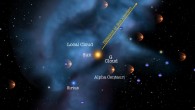
An international team of scientists has found interstellar iron-60, a radioactive isotope with a half-life of 2.6 million years that is predominantly produced...
Planetary researchers from the University of Texas at Austin and NASA’s Marshall Space Flight Center have used dry paleolakes and riverbeds to determine...
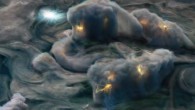
A new study suggests that during Jupiter’s violent storms, hailstones form from a cooled mixture of water and ammonia gas, similar to the process in...
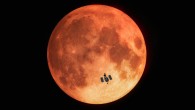
Taking advantage of a total lunar eclipse in January 2019, astronomers using the NASA/ESA Hubble Space Telescope have measured the amount of ozone in the...
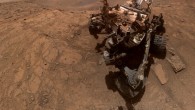
NASA’s Curiosity rover has seen a lot since August 5, 2012, when it first set its wheels inside the huge basin of Gale Crater.
Curiosity rover took this...