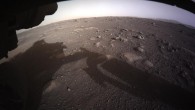
Mission controllers at NASA’s Jet Propulsion Laboratory have received new images from the Perseverance rover as well as health reports from both the...
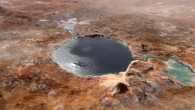
After a 203-day journey, NASA’s car-sized Perseverance rover successfully landed in Jezero Crater on Mars on February 18, 2021. Confirmation of the successful...
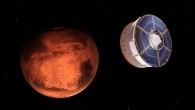
NASA’s Perseverance rover, with the Ingenuity helicopter attached to its belly, is on target to touch down gently in Jezero Crater on Mars around 3:55...
The source of hydrogen chloride (HCl) in the atmosphere of Mars is recent surface volcanism, subsurface magmatic activity, or aerosol chemistry occurring...
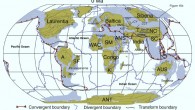
An international team of geoscientists has created the first continuous full-plate model with evolving plate boundaries spanning one billion year ago to...
On Mars, seasonal features known as recurring slope lineae (RSL) are prevalent on Sun-facing slopes. Previous studies have suggested RSL are related to...
Martian atmospheric oxygen, carbon, nitrogen and argon ions have been escaping Mars for billions of years and could be preserved inside the uppermost hundreds...
Solar Orbiter, a collaborative mission between ESA and NASA to study the Sun, has captured a series of images showing three solar system planets: Venus,...
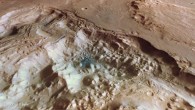
The High Resolution Stereo Camera (HRSC) onboard ESA’s Mars Express orbiter has imaged a fascinating landscape near the major canyon system of Valles...
Using data from the Context Camera aboard NASA’s Mars Reconnaissance Orbiter, planetary researchers have generated an 8-trillion-pixel global map of...
The wings of an angelic figure, complete with halo, can be seen sweeping up and off the top of the frame in a new image from ESA’s Mars Express spacecraft,...
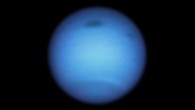
In 2018, astronomers using the NASA/ESA Hubble Space Telescope spotted a giant dark storm, which is 7,400 km (4,600 miles) across, in the northern hemisphere...
In a new study published in the Planetary Science Journal, a team of U.S. scientists combined experimentally verified data on brine evaporation rates along...
According to a new study published in the journal Science Advances, the Martian subsurface would have been the most habitable region for simple life forms...
The active Martian water cycle, i.e., the presence of shallow water and soluble perchlorate salts in the Martian soil, enables the production of hydrogen...
Glycine and other amino acids form in dense interstellar clouds well before they transform into new stars and planets, suggests a new study led by researchers...
Mars was once a wet planet, but it has lost most of its water through reactions that produce hydrogen. In standard models, molecular hydrogen produced...
The thermal evolution of rocky planets depends on the heat input from three long-lived radiogenic elements: potassium, thorium, and uranium. Concentrations...