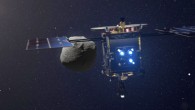
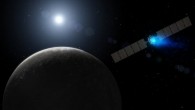
After a journey of 42 months and 2 billion miles (3.2 billion km), Japan Aerospace Exploration Agency’s Hayabusa-2 spacecraft finally reached its intended...
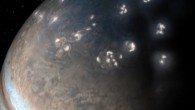
High-resolution infrared images from the Jovian Infrared Auroral Mapper (JIRAM) on NASA’s Juno spacecraft show that, rather than casting one ‘shadow’...
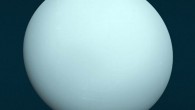
According to a Durham University-led study, young Uranus was hit by a protoplanet about twice the size of Earth that caused the ice giant to tilt and could...
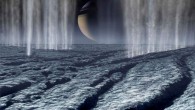
Using data from NASA’s Cassini spacecraft, a research team led by University of Heidelberg scientists Frank Postberg and Nozair Khawaja found that complex,...
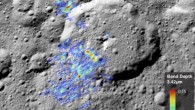
A new analysis of data collected by NASA’s Dawn orbiter suggests that organic molecules may exist in surprisingly high concentrations on the surface...
Around 1.4 billion years ago, a day on Earth lasted approximately 18.7 hours, according to a study published in the Proceedings of the National Academy...
A team of planetary researchers at the University of Colorado at Boulder has offered up a new theory for the existence of strange trans-Neptunian objects...
NASA’s Mars rover Curiosity has detected organic molecules in 3-billion-year-old sedimentary rocks at the base of the Murray formation at Pahrump Hills,...
Ever since NASA’s Voyager 1 flew past Jupiter in 1979, planetary researchers have wondered about the origin of Jovian lightning. That encounter confirmed...
NASA’s Dawn spacecraft is maneuvering to its lowest-ever orbit for a close-up examination of the dwarf planet Ceres.
This artist’s concept shows NASA’s...
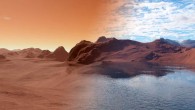
Iron-rich rocks near ancient lake sites on Mars are the most promising and best understood astropaleontological targets, according to new research led...
Planetary researchers working with data from NASA’s New Horizons and ESA’s Rosetta missions have developed a new theory for the formation of the dwarf...
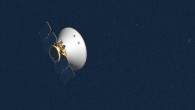
NASA’s Interior Exploration using Seismic Investigations, Geodesy and Heat Transport (InSight) spacecraft is currently cruising to Mars. On May 22, 2018,...
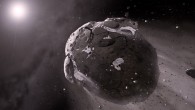
2015 BZ509, an object in Jupiter’s co-orbital region with a retrograde motion around the Sun, is the first known asteroid to have been captured from...