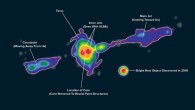
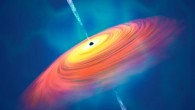
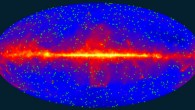
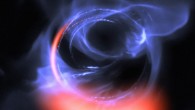
There is a supermassive black hole of nearly 4 million solar masses at the center of our Milky Way Galaxy. A large reservoir of hot and cooler hydrogen...
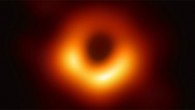
Astronomers using the Event Horizon Telescope (EHT) — a planet-scale array of eight ground-based radio telescopes (ALMA, APEX, the IRAM 30-m telescope,...
Astronomers using NSF’s Karl G. Jansky Very Large Array (VLA) have caught the direct image of the thick torus surrounding the supermassive black hole...
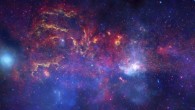
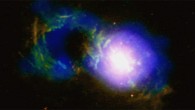
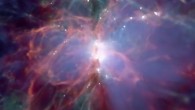
A new immersive, 360-degree, ultra-high-definition visualization provides more details of what NASA’s Chandra X-ray Observatory sees in X-rays around...
Astronomers using the Subaru Telescope have discovered 83 quasars in the distant Universe, from a time when the Universe was less than 10% of its present...
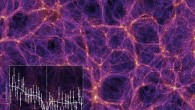
About a third of the normal matter — meaning hydrogen, helium and other elements — created shortly after the Big Bang is not seen in the present-day...
When the Universe was less than 1 billion years old, some of its stars turned into supermassive black holes. A key mystery in astronomy has been: why are...
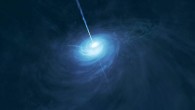
Astronomers using the NASA/ESA Hubble Space Telescope have spotted the brightest quasar ever seen in the early Universe.
Less than a billion years after...
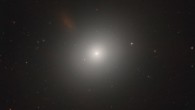
The NASA/ESA Hubble Space Telescope has captured an amazing new photo of the giant elliptical galaxy Messier 105.
This new image from Hubble shows an elliptical...
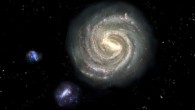
The Large Magellanic Cloud, a dwarf galaxy located approximately 163,000 light-years away, is on a collision course with the Milky Way with which it will...
Supermassive black holes that lurk at the center of most galaxies are surrounded by coronas — mysterious features that are sources of highly energetic...
Astronomers believe that our Universe began forming the first stars when it was a few hundred million years old. Since then, the Universe has become a...
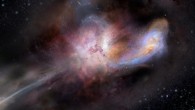
WISE J224607.55-052634.9 (W2246-0526 for short), the most luminous galaxy ever discovered, is accreting (eating) at least three of its smaller neighbors,...
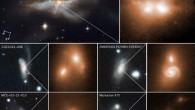
A team of astronomers led by Michael Koss of Eureka Scientific Inc. has observed several pairs of galaxies in the final stages of merging together into...
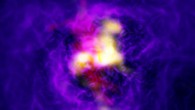
Astronomers using the Atacama Large Millimetre/submillimetre Array (ALMA) have observed a supermassive black hole acting like a ‘monumental fountain’...
Astronomers using the GRAVITY instrument on ESO’s Very Large Telescope Interferometer (VLTI) have detected flares of infrared radiation coming from the...
The NASA/ESA Hubble Space Telescope has captured a vivid image of the unbarred spiral galaxy NGC 5033.
This Hubble image shows the spiral galaxy NGC 5033....
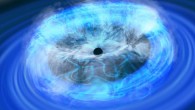
For the first time, a new computer simulation that incorporates the physical effects of Einstein’s general theory of relativity shows that gas in supermassive...
University of Leicester’s Professor Ken Pounds and co-authors report the detection of matter falling into a black hole at 30% of the speed of light.
This...