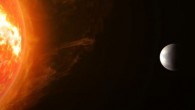
Astronomers from the CARMENES (Calar Alto high-Resolution search for M dwarfs with Exoearths with Near-infrared and optical Échelle Spectrographs) consortium...
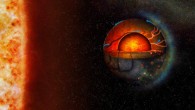
LHS 3844b’s hemispheric tectonics is the direct consequence of a significant temperature contrast between its day- and nightside and is absent in the...
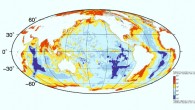
Radionuclides are ubiquitous in sediment and rock, where their decay leads to the production of hydrogen and oxidized chemicals via radiolysis of water;...
In a study published in the journal Science Advances, a team of European astronomers shows that water can be delivered to a terrestrial planet in the form...
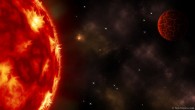
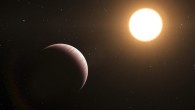
A team of astronomers from Spain, Italy and Germany has discovered a short-period super-Earth exoplanet circling the nearby red dwarf Gliese 740.
An artist’s...
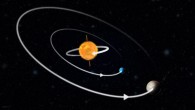
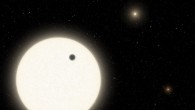
K2-290A, the primary star in the triple stellar system K2-290, is tilted by 124 degrees compared with the orbits of both of its known planets, and has...
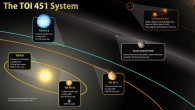
Astronomers using NASA’s Transiting Exoplanet Survey Satellite (TESS) have discovered a trio of hot planets orbiting a much younger version of our Sun...
Astronomers have detected lithium in the atmospheres of four cool and old white dwarfs, of which one also displayed atmospheric potassium. The relative...
Using a newly developed system for mid-infrared exoplanet imaging, astronomers from the Breakthrough Watch Initiative say they can now use ground-based...
Magnetic interactions between the newfound planet, designated Gliese 1151b, and its host star are the likely source of low-frequency radio emission recently...
A team of astronomers from the University of Groningen, the University of Edinburgh, and SRON Netherlands Institute for Space Research has detected chromium...
Astronomers using ESA’s CHaracterising ExOPlanet Satellite (CHEOPS) have discovered a fifth planet around the bright, Sun-like star HD 108236.
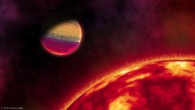
An artist’s...
The seven rocky exoplanets orbiting TRAPPIST-1, an ultracool dwarf star located 38.8 light-years away in the constellation Aquarius, are about 8% less...
The TOI-178 planetary system, a 7.1-billion-year-old system of six planets in the super-Earth to mini-Neptune range, five of which are locked in a rare...
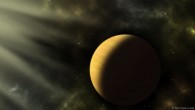
With a mass of 1.8 Neptune masses and a radius of Jupiter, WASP-107b presents a challenge to planet formation theories.
An artist’s impression of WASP-107b....
Shortly after NASA’s Kepler mission began operations back in 2009, it identified what was thought to be a planet about the size of Neptune. Called KOI-5Ab,...
Astronomers using NASA’s Transiting Exoplanet Survey Satellite and the High Resolution Echelle Spectrometer on the Keck I telescope at the W. M. Keck...
NGTS-14Ab, an alien world slightly larger than Neptune orbiting around an orange dwarf in the binary system NGTS-14, joins a growing number of exoplanets...
Astronomers using data from the HATNet (Hungarian-made Automated Telescope Network) survey have discovered a transiting giant planet orbiting the K5-type...
Astronomers using the LOw Frequency Array (LOFAR), a large radio telescope network located mainly in the Netherlands, have detected circularly polarized...