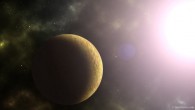
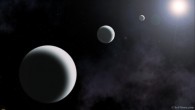
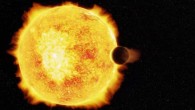
Astronomers using data from NASA’s Transiting Exoplanet Survey Satellite (TESS) have discovered two exoplanets transiting inactive red dwarf stars TOI-122...
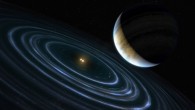
Astronomers are still searching for a hypothetical Planet Nine in the distant reaches of the Solar System, but an 11-Jupiter-mass planet called HD 106906b...
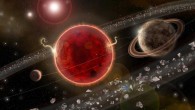
In a new study published in the Astrophysical Journal Letters, astronomers investigated the effects the activity of the red dwarf star Proxima Centauri...
Glycine and other amino acids form in dense interstellar clouds well before they transform into new stars and planets, suggests a new study led by researchers...
Astronomers using NASA’s Transiting Exoplanet Survey Satellite (TESS) and the Echelle SPectrograph for Rocky Exoplanets and Stable Spectroscopic Observations...
The thermal evolution of rocky planets depends on the heat input from three long-lived radiogenic elements: potassium, thorium, and uranium. Concentrations...
Water may emerge in connection with the formation of terrestrial planets, according to a new analysis of a Martian meteorite called North West Africa (NWA)...
Using computer simulations, an international team of astronomers has studied the weather conditions on K2-141b, an Earth-size exoplanet with supersonic...
Barnard’s star, a 10-billion-year-old red dwarf just 6 light-years from Earth, is still very active and potentially destructive for the atmospheres of...
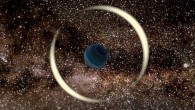
Astronomers from the OGLE (Optical Gravitational Lensing Experiment) project have discovered a Mars- to Earth-mass free-floating, or rogue, planet through...
Using data collected by the InfraRed Array Camera aboard NASA’s Spitzer Space Telescope and NASA’s Transiting Exoplanet Survey Satellite (TESS), astronomers...
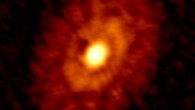
Astronomers using the Atacama Large Millimeter/sub-millimetre Array (ALMA) have observed the emission from dust grains in the protoplanetary disk around...
Using data gathered by NASA’s Transiting Exoplanet Survey Satellite (TESS) and ESA’s Gaia satellite, a team of U.S. astronomers has identified 1,004...
Astronomers using the HARPS (High Accuracy Radial velocity Planet Searcher) spectrograph at ESO’s La Silla Observatory in Chile have detected gaseous...
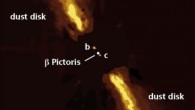
Astronomers using ESO’s Very Large Telescope Interferometer have captured the first direct images of the recently-discovered giant planet Beta Pictoris...
An international team of astronomers has discovered a hot terrestrial planet orbiting the rapidly-rotating low-mass star TOI-540.
An artist’s impression...
A team of geobiologists and astronomers from the United States and Germany has identified 24 extrasolar planets that may have conditions more suitable...
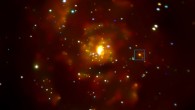
Astronomers using NASA’s Chandra X-ray Observatory have detected an extragalactic candidate planet circling a binary system in Messier 51 (also known...
Astronomers have discovered an ultra-short-period Neptune-sized exoplanet orbiting the bright Sun-like star LTT 9779.
An artist’s impression of the ultrahot...
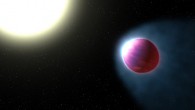
Because of its proximity to its parent star, the dayside equilibrium temperature of the ultrahot Jupiter WASP-189b reaches 3,162 degrees Celsius (5,724...