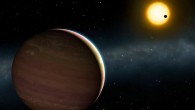
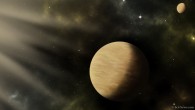
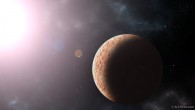
Astronomers using the SuperWASP-North telescope on La Palma in the Canary Islands, Spain, and the SOPHIE spectrograph at the Observatoire de Haute-Provence,...
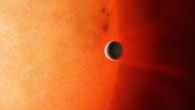
Using NASA’s Transiting Exoplanet Survey Satellite (TESS) and several ground-based telescopes, astronomers have discovered and confirmed a warm super-Neptune...
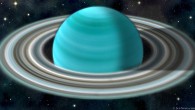
The newly-discovered planetary core, named TOI-849b, is a gas giant that was either stripped of its gaseous atmosphere or that failed to form one in its...
New observations from NASA’s Transiting Exoplanet Survey Satellite (TESS) have enabled astronomers to improve their understanding of the bizarre environment...
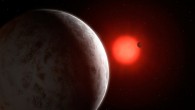
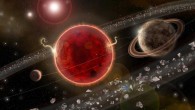
A team of astronomers from the RedDots project has discovered two super-Earths and a candidate planet orbiting the nearby 4.57-billion-year-old red dwarf...
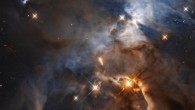
Astronomers using the NASA/ESA Hubble Space Telescope have captured striking images of HBC 672’s unseen protoplanetary disk casting a huge shadow across...
The Breakthrough Listen Initiative, the largest ever scientific research program aimed at finding evidence of alien civilizations, has conducted a search...
Astronomers using NASA’s Transiting Exoplanet Survey Satellite (TESS) and Spitzer Space Telescope have discovered a planet about the size of Neptune...
Astronomers have discovered and validated two small exoplanets orbiting the nearby red dwarf star TOI-1266.
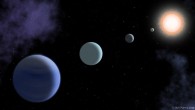
An artist’s impression of the TOI-1266 planetary...
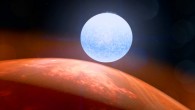
Using data from NASA’s Transiting Exoplanet Survey Satellite (TESS) and Spitzer Space Telescope, astronomers have discovered a transiting hot-Jupiter...
A team of U.S. astronomers has calculated internal heating rates for 53 terrestrial exoplanets and found that all of them are likely to have volcanic activity...
Using data from NASA’s Kepler/K2 mission, the SPECULOOS telescopes and the High Resolution Echelle Spectrometer (HIRES) on the Keck I telescope at W.M....
New estimate suggests that 18% of Sun-like (G-type) stars could have a planet the size of Earth orbiting in their conservative habitable zone.
There may...
Using the assumption that intelligent life develops on exoplanets in a similar way as it does on Earth, a duo of researchers from the School of Physics...
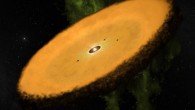
Peter Pan disks are a recently-discovered class of long-lived protoplanetary disks around low-mass stars that survive 5-10 times longer than typical protoplanetary...
Astronomers using data from NASA’s Kepler space telescope have discovered two new planets in the Kepler-160 planetary system. One of the new planets...
Astronomers using the NASA/ESA Hubble Space Telescope have observed young stars in a crowded stellar cluster called Westerlund 2. They’ve found that...
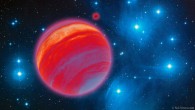
Using three instruments on ESO’s Very Large Telescope (VLT), an international team of astronomers has discovered and imaged a giant sub-stellar object...