In March 2021, NASA’s Curiosity rover observed clouds made of carbon dioxide (CO2) ice at high altitudes in the atmosphere of Mars.
Curiosity captured...
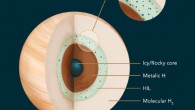
Jupiter, Saturn and numerous giant exoplanets discovered to date consist mostly of hydrogen and helium. In 1977, planetary scientists predicted the existence...
Astronomers using the Atacama Large Millimeter/submillimeter Array (ALMA) have produced a detailed map of intensity and abundance of gaseous hydrogen cyanide...
NASA’s Perseverance rover is focusing its science instruments on rocks that lay on the floor of Jezero Crater, which is located on the western edge of...
Three images of Jupiter from the 8-m Frederick C. Gillett Gemini North telescope at the Gemini Observatory and the NASA/ESA Hubble Space Telescope show...
Volcanic activity on Mars peaked during the Noachian and Hesperian periods, between 3 and 4 billion years ago, with smaller eruptions in isolated locations...
NASA’s Perseverance rover used a microphone on its SuperCam laser instrument to listen as the Ingenuity helicopter flew for the fourth time on April...
Detailed measurements from the Grand Finale phase of NASA’s Cassini mission revealed distinctive features of Saturn’s magnetic field. These features...
On July 11, 2020, NASA’s Parker Solar Probe made its third flyby of Venus. During 7 min around the closest approach, one of the spacecraft’s scientific...
Astronomers using Earth-based radar observations have measured some of the fundamental properties of the planet Venus: the precise length of a day, the...
Reconstructing the emergence and weathering of Earth’s continental crust in the Archean eon is crucial for our understanding of early ocean chemistry,...
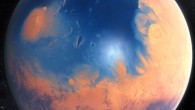
Mars is cold today but once had water lakes and flowing rivers. The early warm climate cannot be explained by basic models of the early Mars greenhouse...
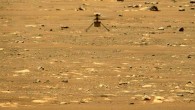
NASA’s Ingenuity helicopter took off at 4:31 a.m. EDT (1:31 a.m. PDT), or 12:33 p.m. local Mars time, on April 25, 2021, rising 5 m (16 feet); then it...
On April 20, 2021, the Mars Oxygen In-Situ Resource Utilization Experiment (MOXIE) instrument aboard NASA’s Perseverance rover converted some of carbon...
Lasting 51.9 seconds, Ingenuity’s experimental flight on April 22, 2021, added several new challenges to its first flight, including a higher maximum...
Mars had drier and wetter eras before drying up completely in the Hesperian period, about 3 billion years ago, according to an analysis of observational...
In a new paper published in the journal Earth and Planetary Science Letters, an international team of researchers presents the results from a long-term...
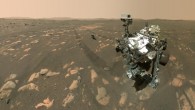
Perseverance took a selfie with the Ingenuity helicopter, seen here 4 m (13 feet) away in this image from April 6, 2021.
This image was taken by the WATSON...
A new study published in the Journal of Geophysical Research: Planets is a first step toward a generalized theory of how precipitation and condensible...