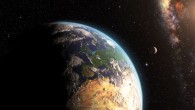
Ocean worlds are planetary bodies that have a liquid ocean, often under an icy shell or within the rocky interior. In our own Solar System, several moons...
Jupiter’s upper atmosphere is composed of a neutral thermosphere and charged ionosphere. Astronomers using the NASA/ESA/CSA James Webb Space Telescope...
Titan, Saturn’s largest moon, is the only known planetary body besides Earth on which standing liquids persist. Liquid hydrocarbons, supplied by rainfall...
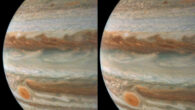
Jupiter’s Great Red Spot is probably the best known atmospheric feature and a popular icon among solar system objects. Its large oval shape, contrasted...
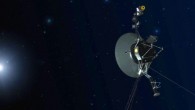
Voyager 1 is conducting science operations for the first time following a technical issue that arose in November 2023.
Voyager 1 launched from Florida’s...
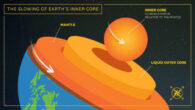
Movement of the inner core of our planet has been debated by the scientific community for two decades, with some research indicating that the inner core...
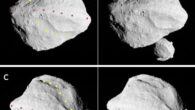
Dinkinesh is a small asteroid orbiting the Sun near the inner edge of the main asteroid belt. NASA’s Lucy spacecraft recently revealed the asteroid,...
Using high-resolution color images from ESA’s Trace Gas Orbiter (TGO) and Mars Express missions, planetary researchers have found evidence for morning...
Cold, dense clouds in the interstellar medium of our Milky Way Galaxy are around four-five orders of magnitude denser than their diffuse counterparts....
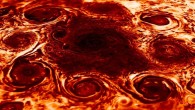
Planetary scientists first made the connection between Earth and Jupiter in 2018 when they noticed a striking similarity between images of Jupiter’s...
The Negative Ions at the Lunar Surface (NILS) instrument onboard China’s Chang’e-6 probe has detected negative ions on the surface of the Moon. These...
Analyzing 4-billion-year-old zircon crystals from the Jack Hills in Western Australia’s Mid West region, geoscientists have pushed back the timeline...
Using the SHARK-VIS instrument on the Large Binocular Telescope on Mount Graham in Arizona, the United States, astronomers have captured the highest resolution...
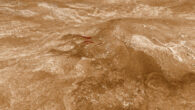
Using radar data from NASA’s Magellan mission, planetary scientists have detected volcanic-related flow features in two different regions of Venus: on...
Planetary researchers from Washington University in St. Louis and the Lunar and Planetary Institute have used mathematical models and unprecedented high-resolution...
NASA’s Juno orbiter captured these views of the tiny, red moon Amalthea and its parent planet and during a close flyby on March 7, 2024.
These views...
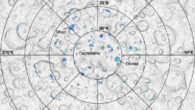
The dwarf planet Ceres hosts permanently shadowed areas in its polar regions, and these regions are an interesting analog to Mercury and the Moon. Ceres’...
An ultra-weak geomagnetic field between 591 and 565 million years ago (Ediacaran period) coincided with a significant increase in the oxygen levels in...
Titan, the largest moon of Saturn, harbors an internal low-density ocean of water or ammonia, according to an analysis of archival data from NASA’s Cassini...