Astronomers using the Atacama Large Millimeter/submillimeter Array (ALMA) have found thousands of dense gas clumps but, surprisingly, no star formation,...
Using spectral data from the Sloan Digital Sky Survey (SDSS), the Chandra Source Catalog 2.0, and the Chandra COSMOS Legacy survey, astronomers have found...
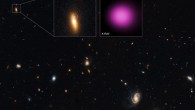
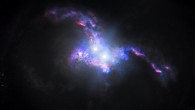
By combining gravitational lensing with the capabilities of NASA’s Chandra X-ray Observatory, astronomers have detected two X-ray-emitting objects —...
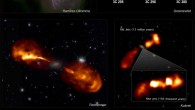
Using data from the Low Frequency Array (LOFAR), a radio telescope that operates at frequencies between 10 and 240 MHz and consists of 52 stations spread...
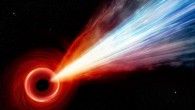
Using ESA’s XMM-Newton and NASA’s NuSTAR space telescopes, astronomers have observed X-ray flares emitted from around the supermassive black hole in...
Astronomers from the Event Horizon Telescope (EHT) Collaboration have imaged a jet in the heart of the nearby radio galaxy Centaurus A and identified the...
Astrophysical observations show that supermassive black holes exist when the Universe is just 800 million years old after the Big Bang (just 6% of its...
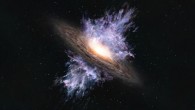
Using the Atacama Large Millimeter/submillimeter Array (ALMA), astronomers have detected a galactic-scale supermassive black hole-driven wind in HSC J124353.93+010038.5...
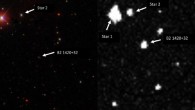
Astronomers using the Multi Unit Spectroscopic Explorer (MUSE) instrument on ESO’s Very Large Telescope (VLT) have performed spectroscopic observations...
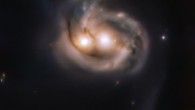
The two newly-discovered pairs of quasars, J0749+2255 and J0841+4825, existed 10 billion years ago and resided in the cores of merging galaxies, according...
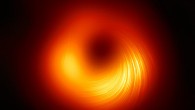
Astronomers using the Event Horizon Telescope (EHT) — a planet-scale array of eight ground-based radio telescopes (ALMA, APEX, the IRAM 30-m telescope,...
Using the Arecibo and Gemini observatories, astronomers have detected a mobile supermassive black hole in a galaxy called SDSS J043703.67+245606.8 (hereafter...
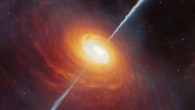
The source of the 160,000-light-year-long jet of particles is PSO J352.4034-15.3373 (PJ352-15 for short), a rapidly growing supermassive black hole, or...
Astronomers using several ground-based telescopes have spotted the most distant cosmic jet discovered so far. Its source is PSO J172.3556+18.7734, a radio-loud...
Theoretical physicists from Italy, Spain and Argentina propose a new mechanism for the creation of supermassive black holes from dark matter.
Galaxy halos...
The majority of supermassive black holes lie dormant and starved of fuel; these hidden giants can be temporarily illuminated when an unlucky star passes...
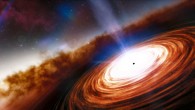
The newly-discovered quasar is located approximately 13.03 billion light-years away from Earth. Designated J031343.84-180636.4 (J0313-1806 for short),...
An active galactic nucleus in the center of ESO 253-G003, an active galaxy over 570 million light-years away in the southern constellation of Pictor, erupts...