Astronomy News

Mar 3, 2016 by Sergio Prostak

Using the NASA/ESA Hubble Space Telescope, astronomers have found a surprisingly bright, infant galaxy 13.4 billion light-years from us, making it the most distant galaxy ever detected. GN-z11, shown in the inset, is seen as it was 13.4 billion years in the past, just 400 million years after the Big Bang. Image credit: NASA / ESA / P. Oesch, Yale University / G. Brammer, STScI / P. van Dokkum, Yale University / G. Illingworth, University of California,...

Mar 2, 2016 by Enrico de Lazaro

For the first time, astronomers have detected repeating short bursts of radio waves — so-called fast radio bursts — coming from an extremely...

Mar 2, 2016 by News Staff

RCW 106, a vast cloud of gas and dust, along with its rich and fascinating surroundings, are captured in this incredible photo from ESO’s VLT Survey...

Feb 29, 2016 by News Staff

The subject of this Hubble image is Hen 2-80, a star located in the constellation Crux at a distance of approximately 2,300 light-years away from Earth. The...

Feb 25, 2016 by News Staff

Cosmic voids — vast underdense regions, forming an essential feature of the cosmic web and occupying most of the volume of the Universe — could...

Feb 25, 2016 by Enrico de Lazaro

An international team of astronomers reported today that they had tracked down the location of a so-called fast radio burst (FRB), a mysterious and rarely...

Feb 24, 2016 by News Staff

Using the Atacama Pathfinder Experiment (APEX), a 12-m radio telescope at 5,100 m altitude in the Chilean Atacama desert, astronomers have mapped the full...

Feb 23, 2016 by News Staff

Messier 90, the brightest galaxy in the Virgo Cluster, has a 300,000 light-year-long tail of diffuse ionized gas flowing from it, says an international...

Feb 22, 2016 by Sergio Prostak

WR 31a, a rare example of a massive star, is the subject of this image from the NASA/ESA Hubble Space Telescope. This Hubble image shows WR 31a, a type...

Feb 19, 2016 by Natali Anderson

Using the NASA/ESA Hubble Space Telescope, scientists have discovered that a giant extrasolar planet called 2MASSWJ 1207334-393254b has patchy clouds and...

Feb 17, 2016 by News Staff

This incredible image, taken with the Advanced Camera for Surveys (ACS) on board the NASA/ESA Hubble Space Telescope, shows the giant elliptical galaxy...

Feb 17, 2016 by Enrico de Lazaro

Using the NASA/ESA Hubble Space Telescope, European astronomers have been able to examine the atmosphere of the extrasolar planet 55 Cancri e in unprecedented...

Feb 17, 2016 by Natali Anderson

Using the Atacama Large Millimeter/submillimeter Array (ALMA) radio telescope in Chile, an astronomer from the United States has taken a detailed look...

Feb 15, 2016 by News Staff

The NASA/ESA Hubble Space Telescope has captured a remarkable image of a reflection nebula known as IRAS 00044+6521. This Hubble ACS image shows the irregular...

Feb 10, 2016 by News Staff

An infant star lights up the nebula IC 2631 in this remarkable new image from the MPG/ESO 2.2-m telescope at ESO’s La Silla Observatory, Chile. This...

Feb 9, 2016 by News Staff

Almost 900 hidden nearby galaxies have been studied by an international team of astronomers, shedding new light on the Great Attractor — a diffuse...

Feb 8, 2016 by News Staff

The NASA/ESA Hubble Space Telescope has captured this vivid image of the startlingly symmetrical nebula Hen 2-437. This Hubble image shows the young planetary...

Feb 3, 2016 by News Staff

A group of European astronomers led by Laboratoire d’Astrophysique de Bordeaux scientist Stephane Guilloteau has measured the temperature of large...

Feb 1, 2016 by News Staff

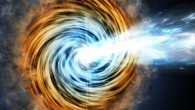
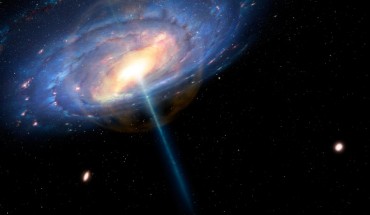
This artist’s concept shows an active supermassive black hole with a jet streaming outward at nearly the speed of light. Such black holes are often found...

Feb 1, 2016 by Enrico de Lazaro

The NASA/ESA Hubble Space Telescope has taken an amazing picture of a peculiar galaxy, NGC 1487. NGC 1487, pictured in this Hubble WFPC2 image, is the...