Astronomy News

Jun 30, 2016 by News Staff

A team of astronomers from the UK is exploring what might be described as the first astronomical observing tool, potentially used by humans around 4,000 BC. The view towards the east from the Carregal do Sal megalithic cluster, at dawn at the end of April around 4,000 BC, as reconstructed using a Digital Elevation Model and Stellarium. Aldebaran, the last star to rise before the Sun, is rising directly above Serra da Estrela, the ‘mountain range...

Jun 30, 2016 by News Staff

Almost 55 percent of the star formation arises from minor mergers between galaxies, according to an astronomer who analyzed data collected as part of the...

Jun 29, 2016 by News Staff

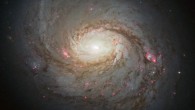
The newest photo from the NASA/ESA Hubble Space Telescope is of a rare type of galaxy, known as a ‘tadpole.’ Kiso 5639 is a member of a class of galaxies...

Jun 28, 2016 by News Staff

Amazing new infrared images and high-resolution maps of Jupiter give a glowing view of Juno’s target, several days ahead of the NASA mission’s arrival...

Jun 27, 2016 by News Staff

The NASA/ESA Hubble Space Telescope has produced an absolutely beautiful image of the interior of NGC 1569, one of the most active galaxies in our local...

Jun 23, 2016 by Natali Anderson

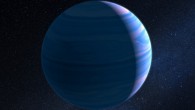
A team of astronomers detected a dark spot in the atmosphere of Neptune, in images taken with the NASA/ESA Hubble Space Telescope on May 16, 2016. This...

Jun 22, 2016 by News Staff

Using ESA’s X-ray space observatory XMM-Newton, astronomers have spotted for the first time an enigmatic cloud of high-energy particles called a wind...

Jun 21, 2016 by Natali Anderson

An international team of astronomers has spotted a Neptune-sized exoplanet orbiting a very young star approximately 500 light-years from our own Solar...

Jun 20, 2016 by Natali Anderson

This NASA/ESA Hubble Space Telescope image shows NGC 1854, a globular star cluster in the southern constellation of Dorado. This image shows NGC 1854,...

Jun 17, 2016 by Enrico de Lazaro

Astronomers using the Atacama Large Millimeter/submillimeter Array (ALMA) have found the most distant oxygen yet seen in the Universe, in a galaxy 13.1...

Jun 17, 2016 by News Staff

Astronomers have found that there are far more so-called hot-Jupiter planets – gas giants that orbit very close to their parent stars – than...

Jun 16, 2016 by Natali Anderson

According to astronomers at NASA’s Center for Near-Earth Object (NEO) Studies, a near-Earth asteroid designated 2016 HO3 is currently following a stable...

Jun 15, 2016 by Natali Anderson

Astronomers using the Atacama Large Millimeter/Submillimeter Array (ALMA) have detected gas-phase methanol (methyl alcohol) in the protoplanetary disc...

Jun 15, 2016 by Enrico de Lazaro

Astronomers using highly sensitive radio telescopes have detected, for the first time, a chiral molecule in interstellar space. Astronomers applaud the...

Jun 14, 2016 by News Staff

Cloud or haze layers in the upper atmospheres of extrasolar planets may make them appear bigger than they really are, a study led by Dr. Helmut Lammer...

Jun 13, 2016 by Natali Anderson

Astronomers using NASA’s Kepler Space Telescope have found a Jupiter-like exoplanet orbiting around a pair of Sun-like stars. Comparison of the relative...

Jun 13, 2016 by News Staff

This new image taken with the NASA/ESA Hubble Space Telescope depicts blue stars in the constellation of Sagittarius. This image, taken with the Advanced...

Jun 10, 2016 by News Staff

Hot, Jupiter-sized extrasolar planets often have cloud or haze layers in their atmospheres, and this may prevent astronomers from detecting atmospheric...

Jun 9, 2016 by News Staff

Astronomers searching for the Milky Way’s youngest exoplanets have uncovered strong evidence for one unlike any other, a so-called ‘hot-Jupiter’...

Jun 8, 2016 by News Staff

A multinational team of astrophysicists has recorded the ‘sounds’ from some of the oldest stars in our Milky Way Galaxy. This wide-field view is centered...