Astronomy News

Aug 2, 2016 by News Staff

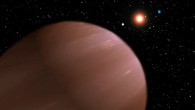
The Universe is 13.8 billion years old, while Earth formed 4.5 billion years ago. Some cosmologists think this time gap means that life on other planets could be billions of years older than ours. However, a theoretical study by scientists from the University of Oxford and Harvard University suggests that life is actually premature from a cosmic perspective. This is an artist’s impression of an exoplanet. Image credit: Ron Miller. “If you...

Aug 1, 2016 by Natali Anderson

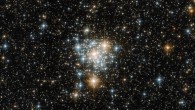
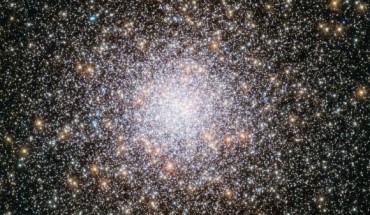
This image from Hubble’s Advanced Camera for Surveys (ACS) is likely the best of the star cluster NGC 4833. This image shows a small but bright globular...

Jul 28, 2016 by News Staff

An international team of astronomers led by Texas Tech University scientist Dr. Christopher Britt has spotted a very young star, called CXOGBS J173643.8-282122...

Jul 27, 2016 by News Staff

Astronomers announced today that they have discovered a new type of binary star, in which a rapidly-spinning white dwarf star sweeps powerful beams of...

Jul 27, 2016 by News Staff

The gaseous halo of our Milky Way Galaxy is spinning in the same direction and at a similar speed as the Galaxy’s disk, which contains stars, planets,...

Jul 25, 2016 by News Staff

A new image taken with the NASA/ESA Hubble Space Telescope provides a detailed look at the remains of a supernova explosion known as DEM L316A. This image...

Jul 21, 2016 by News Staff

The NASA/ESA Hubble Space Telescope has captured a striking photo of Abell S1063, a massive cluster of galaxies in the constellation Grus. In the center...

Jul 21, 2016 by Enrico de Lazaro

TRAPPIST-1b and c, the two innermost planets in the three-planet system TRAPPIST-1, are primarily rocky, unlike gas giants such as Jupiter, according to...

Jul 20, 2016 by Sergio Prostak

A team of astronomers has reported a huge haul of new exoplanets discovered and confirmed using data from the first year of the Kepler/K2 mission. Among...

Jul 18, 2016 by News Staff

This image, taken with the Advanced Camera for Surveys (ACS) on board the NASA/ESA Hubble Space Telescope, shows the star-forming galaxy NGC 3125. This...

Jul 15, 2016 by News Staff

Astronomers from the Baryon Oscillation Spectroscopic Survey (BOSS, part of the Sloan Digital Sky Survey III) have produced the largest-ever 3D map of...

Jul 14, 2016 by News Staff

Astronomers using the Atacama Large Millimeter/submillimeter Array (ALMA) telescope have taken the first-ever image of a water snow-line within a protoplanetary...

Jul 12, 2016 by Enrico de Lazaro

Astronomers have discovered a new dwarf planet in the Kuiper Belt, a vast ring of icy debris that is encircling the outer rim of our Solar System just...

Jul 12, 2016 by News Staff

A group of astronomers has used the High Acuity Wide-field K-band Imager (HAWK-I), an infrared instrument installed on ESO’s Very Large Telescope (VLT)...

Jul 11, 2016 by News Staff

Astronomers have succeeded in obtaining an infrared spectrum of the recently discovered brown dwarf WISE J085510.83-071442.5 (WISE 0855 for short), providing...

Jul 11, 2016 by News Staff

The subject of this Hubble image is LEDA 56779, a spiral galaxy located 300 million light-years away in the constellation of Hercules. This image from...

Jul 8, 2016 by Natali Anderson

The NASA/ESA Hubble Space Telescope has zoomed in on the center of the Crab Nebula — a ten-light-year-wide remnant of a star’s supernova explosion...

Jul 7, 2016 by Enrico de Lazaro

Using ESO’s Very Large Telescope (VLT), astronomers have found a young Jupiter-like planet in a triple-star system. This artist’s impression shows...

Jul 4, 2016 by News Staff

The NASA/ESA Hubble Space Telescope has imaged an ancient and faint dwarf galaxy called LEDA 677373. This Hubble image shows the dwarf galaxy LEDA 677373....

Jun 30, 2016 by Natali Anderson

The NASA/ESA Hubble Space Telescope has captured stunning new ultraviolet images of the auroral lights in the atmosphere of the Solar System’s largest...