Featured News

Jun 24, 2019 by News Staff

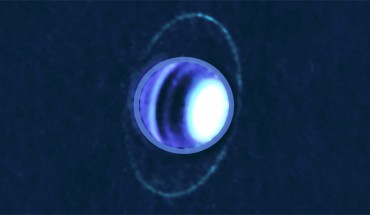
The rings of the ice giant Uranus are invisible to all but the largest telescopes — they weren’t even discovered until 1977. However, they are surprisingly bright in the new thermal images taken by the Atacama Large Millimeter/submillimeter Array (ALMA) and ESO’s Very Large Telescope (VLT). The new images allowed astronomers for the first time to measure the temperature of rings particles: minus 321 degrees Fahrenheit (minus 196 degrees...

Jun 21, 2019 by News Staff

Narwhals (Monodon monoceros) and beluga whales (Delphinapterus leucas) are medium-sized toothed whales and the sole representatives of the Monodontidae...

Jun 20, 2019 by Enrico de Lazaro

An international research team led by Northeastern University marine biologists has discovered a new genus and species of shipworm burrowing into the bedrock...

Jun 20, 2019 by Enrico de Lazaro

Astronomers using the CARMENES (Calar Alto high-Resolution search for M dwarfs with Exoearths with Near-infrared and optical Échelle Spectrographs) instrument...

Jun 19, 2019 by News Staff

Paleontologists have found two fossilized teeth of extinct cursorial hyenas (genus Chasmaporthetes) in the remote Old Crow River region in northern Yukon...

Jun 18, 2019 by News Staff

An international team of researchers has found that the inhabitants of the Neolithic settlement Çatalhöyük (7100-5950 BCE) experienced overcrowding,...

Jun 18, 2019 by News Staff

According to new research led by Rochester Institute of Technology (RIT), the collision of the recently-discovered dwarf galaxy Antlia 2 with our Milky...

Jun 18, 2019 by News Staff

Domestication shaped wolves (Canis lupus) into dogs (Canis familiaris) and transformed both their behavior and their anatomy. A new study, published in...

Jun 17, 2019 by News Staff

The domesticated almond tree (Prunus amygdalus) has been feeding humans for millennia. Derivation from the wild, bitter, and toxic almond required loss...

Jun 14, 2019 by News Staff

Paleontologists have unearthed fossils of a giant trilobite species that inhabited Australian waters approximately 500 million years ago (Cambrian period). An...

Jun 13, 2019 by News Staff

Professor John Terning and Dr. Christopher Verhaaren from the University of California, Davis, have a new candidate for dark matter — a dark monopole...

Jun 13, 2019 by News Staff

Astronomers using the NASA/ESA Hubble Space Telescope have discovered that the yellow color visible on portions of the surface of Europa, the second Galilean...

Jun 12, 2019 by News Staff

Pterosaurs were winged flying reptiles that lived at the same time as dinosaurs, between 210 million and 65 million years ago. Previously, they were thought...

Jun 11, 2019 by News Staff

A team of biologists from the Universities of Guelph and Toronto has discovered that a species of carnivorous plant called the northern pitcher plant (Sarracenia...

Jun 11, 2019 by News Staff

The South Pole-Aitken basin — the largest crater in the Solar System — is a gigantic impact structure on the far side of the Moon. Data from...

Jun 10, 2019 by News Staff

A 3,300-foot- (1 km) wide asteroid struck our planet 1.2 billion years ago, according to new research published in the Journal of the Geological Society. An...

Jun 10, 2019 by News Staff

The NASA/ESA Hubble Space Telescope has produced a spectacularly detailed image of a spiral galaxy called NGC 4051. This Hubble image shows the intermediate...

Jun 7, 2019 by News Staff

A new species of two-legged iguanodontian dinosaur has been identified from fossils discovered three decades ago in an opal mine in Australia. A paper...

Jun 6, 2019 by News Staff

Coronal mass ejections (CMEs), often associated with solar flares, are the most powerful magnetic phenomena occurring on the Sun. Now, astronomers using...

Jun 5, 2019 by News Staff

An international team of scientists has unearthed a collection of 2.6-million-year-old systematically flaked stone tools at the site of Bokol Dora 1 (BD1)...