Paleontology News

Jul 10, 2020 by News Staff

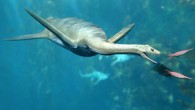
Paleontologists have found and described the first nearly complete skeleton of Ankylorhiza tiedemani, an extinct large dolphin that lived about 24 million years ago (Oligocene epoch). Life restoration of a pod of Ankylorhiza tiedemani. Image credit: Robert Boessenecker. With a body length of 4.8 m (15.7 feet), Ankylorhiza tiedemani was the largest member of the group Odontoceti (toothed whales) during the Oligocene — a size not surpassed until...

Jul 9, 2020 by News Staff

An international team of paleontologists from the UK, Italy and Switzerland has created the first digital reconstruction of the skull of Leithia melitensis,...

Jul 9, 2020 by News Staff

Dilophosaurus wetherilli was the largest animal known to have lived on land in North America during the Early Jurassic. Despite its charismatic presence...

Jul 8, 2020 by News Staff

Paleontologists have uncovered the fossilized jawbone of a juvenile dromaeosaurid (raptor) dinosaur that lived 70 million years ago in what is now northern...

Jul 7, 2020 by News Staff

A new genus and species of ornithodiran — an early relative of dinosaurs and pterosaurs — that lived around 237 million years ago (Triassic...

Jul 1, 2020 by News Staff

The end-Cretaceous mass extinction 66 million years ago eradicated roughly 75% of the animal and plant species on Earth, including whole groups like non-avian...

Jul 1, 2020 by News Staff

Paleontologists have discovered striking similarities between the fossilized bones of giant penguins that lived 62 million years ago in what is now New...

Jun 29, 2020 by News Staff

Thylacosmilus atrox, an extinct marsupial that roamed South America between 9 and 3 million years ago (Neogene period), was not the ecological analogue...

Jun 26, 2020 by News Staff

Paleontologists have identified a giant wombat-like marsupial that lived 25 million years ago (Oligocene epoch) in what is now Australia. Named Mukupirna...

Jun 23, 2020 by Enrico de Lazaro

A team of U.S. paleontologists has redescribed the morphology of a long-snouted ray-finned fish called Tanyrhinichthys mcallisteri and created a more complete...

Jun 23, 2020 by News Staff

An international team of geologists has found the first direct evidence that volcanic eruptions in the southern part of the Siberian Traps region 252 million...

Jun 22, 2020 by News Staff

Paleontologists have analyzed 151- to 165-million-year-old dinosaur footprints from 11 sites in southern Queensland, most of which produced large (length...

Jun 19, 2020 by News Staff

A giant fossilized egg of an extinct marine reptile has been found in the 68-million-year-old nearshore marine deposits in Antarctica. An artist’s rendering...

Jun 18, 2020 by News Staff

A team of paleontologists from the United States, Canada and Argentina has analyzed the fossilized eggs of two different non-avian dinosaurs, Protoceratops...

Jun 17, 2020 by Enrico de Lazaro

Paleontologists have identified a new genus and species of fern-like plant from a single fossilized specimen collected in the New England region of New...

Jun 12, 2020 by News Staff

Multiple, well-preserved trackways made by large crocodylomorphs, extinct ancestors of modern-day crocodiles, between 110 and 120 million years ago (Cretaceous...

Jun 10, 2020 by Enrico de Lazaro

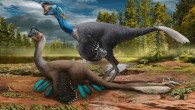
A new genus and species of paravian theropod dinosaur has been identified from fossils found in Patagonia, Argentina. Life reconstruction of an adult and...

Jun 5, 2020 by Enrico de Lazaro

Two new transitional species of plant-eating horned dinosaurs have been unearthed in New Mexico, the United States. Navajoceratops sullivani and Terminocavus...

Jun 4, 2020 by News Staff

Paleontologists in Canada have analyzed the fossilized stomach contents from the exceptionally preserved specimen of Borealopelta markmitchelli, a species...

Jun 2, 2020 by News Staff

A 425-million-year-old fossil millipede from Scotland is the oldest-known ‘bug’ (an insect, arachnid or other related creature), according to new research...