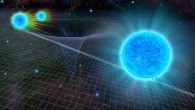
In a test of Einstein’s theory of general relativity near the supermassive black hole at the center of our Milky Way Galaxy, an international group of...
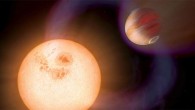
Astronomers using the KPED (Kitt Peak Electron Multiplying CCD demonstrator) instrument at NSF’s Kitt Peak National Observatory have discovered ZTF J153932.16+502738.8,...
Astronomers using NASA’s Transiting Exoplanet Survey Satellite (TESS) have discovered an exoplanet planet larger than Neptune but smaller than Saturn...
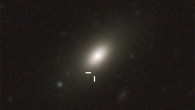
Astronomers have used NASA’s Transiting Exoplanet Survey Satellite (TESS) to see what was happening around the supernova ASASSN-18tb in the first moments...
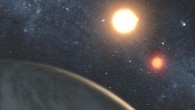
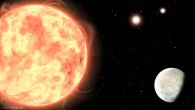
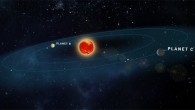
Astronomers using NASA’s Transiting Exoplanet Survey Satellite (TESS) have discovered a terrestrial planet orbiting a star in the triple-star system...
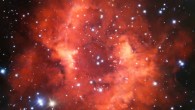
The European Southern Observatory (ESO) has released a beautiful photo taken by the FORS (FOcal Reducer and Spectrograph) instrument on the Very Large...
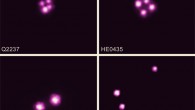
By combining the capability of NASA’s Chandra X-ray Observatory with the power of a natural phenomenon called gravitational lensing, a team of astronomers...
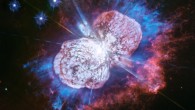
Eta Carinae is a binary stellar system approximately 7,500 light-years away in the constellation Carina. Also known as HD 93308 and Hen 3-481, the system...
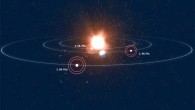
Astronomers using NASA’s Transiting Exoplanet Survey Satellite (TESS) have discovered three small planets orbiting a bright M-dwarf star called L 98-59....
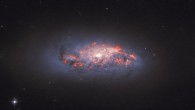
The NASA/ESA Hubble Space Telescope has captured a striking new photo of the spiral galaxy NGC 972.
This Hubble image shows a spiral galaxy called NGC...
Astronomers using the CARMENES (Calar Alto high-Resolution search for M dwarfs with Exoearths with Near-infrared and optical Échelle Spectrographs) instrument...
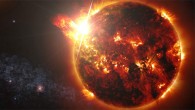
Coronal mass ejections (CMEs), often associated with solar flares, are the most powerful magnetic phenomena occurring on the Sun. Now, astronomers using...
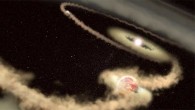
Astronomers using the Multi Unit Spectroscopic Explorer (MUSE) spectrograph on ESO’s Very Large Telescope have directly imaged two still-forming gas...
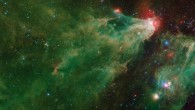
A large celestial mosaic from NASA’s Spitzer Space Telescope shows multiple clusters of stars and clouds of gas and dust in the constellation of Cepheus.
This...
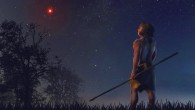
Between 8 and 2 million years ago, cosmic-ray energy from one or more nearby supernovae reached Earth and pummeled the planet’s atmosphere, initiating...
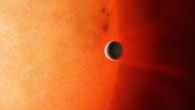
An international team of astronomers has discovered a Neptune-sized exoplanet orbiting NGTS-4, a K-dwarf star located 922 light-years from Earth. Named...
Astronomers using NASA’s Transiting Exoplanets Survey Satellite (TESS) have discovered a compact three-planet system around the sixth-magnitude star...
A team of astronomers from the Max Planck Institute for Solar System Research, the Georg August University of Göttingen and Sonneberg Observatory has...