Microbiologists have discovered a new species of heat-loving amoeba that divides at 63 degrees Celsius (145 degrees Fahrenheit) and remains motile up to 64 degrees Celsius (147 degrees Fahrenheit).
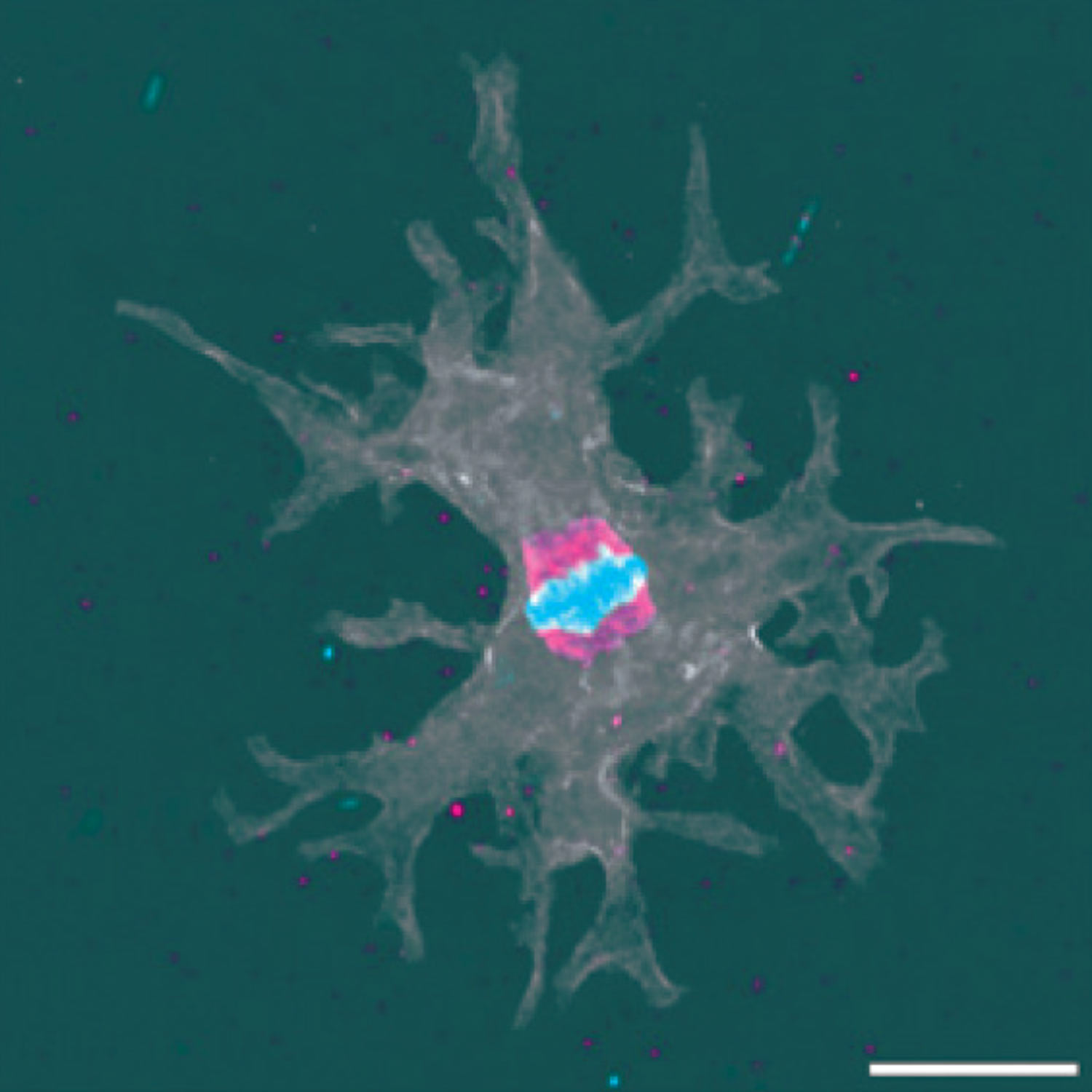
Incendiamoeba cascadensis undergoes cellular replication up to 63 degrees Celsius. Image credit: Rappaport et al., doi: 10.1016/j.cell.2026.08.043.
For decades, the accepted upper temperature limit for eukaryotic life — organisms whose cells contain a nucleus, including everything from fungi to animals — hovered around 60 degrees Celsius (140 degrees Fahrenheit), based on a handful of heat-tolerant fungi and red algae.
A few amoebae had pushed slightly past that, with one species topping out near 57 degrees Celsius (135 degrees Fahrenheit).
The newly discovered species of amoeba, Incendiamoeba cascadensis, or fire amoeba, breaks well past both marks, completing full cell division, including visible mitosis, at 63 degrees Celsius.
“Thermophiles are organisms with high thermal limits and optimal growth at or above 45 degrees Celsius (113 degrees Fahrenheit),” said Syracuse University doctoral student Beryl Rappaport and her colleagues.
“Thermal limits are defined by three thresholds: completion of the life cycle (e.g., cellular replication), metabolic activity (e.g., motility and feeding), and survival.”
“The highest known temperature threshold is 122 degrees Celsius (252 degrees Fahrenheit), at which only the archaeon Methanopyrus kandleri can grow.”
“Among bacteria, Geothermobacterium ferrireducens can grow at temperatures up to 100 degrees Celsius (212 degrees Fahrenheit).”
“These growth temperatures are remarkable given the challenges associated with thermal stress, including increased likelihood of protein and other biomolecule denaturation and impacts on membrane fluidity.”
“Surprisingly, parallel efforts to characterize eukaryotic thermophiles and define upper temperature thresholds remain extremely limited,” they added.
“The upper temperature limit of growth commonly cited for eukaryotes is 60 degrees Celsius, supported by a few species of fungi and red algae.”
“Other eukaryotes have been documented growing up to 57 degrees Celsius, including the amoeba Echinamoeba thermarum, ut the majority of eukaryotic diversity in high-temperature environments remains unexplored.”
Rappaport and co-authors isolated Incendiamoeba cascadensis from a tributary of Hot Springs Creek in Lassen Volcanic National Park, California, sampling the site over three years.
Genetic analysis places the species within Amoebozoa, closely related to but genetically distinct from Vermamoeba vermiformis, a heat-tolerant amoeba that tops out near 40-45 degrees Celsius (104-113 degrees Fahrenheit).
The researchers also found matching genetic signatures in metagenomic databases from geothermal sites in New Zealand and Yellowstone National Park, suggesting related organisms may be more widespread than previously known.
“Finding eukaryotes surviving in high temperature environments not only expands our understanding of where life could be found, but also of how complex that life could be,” said Dr. Alison Olcott, program scientist for exobiology at NASA Headquarters, who was not involved in the study.
Comparing gene activity at 48 degrees Celsius (118 degrees Fahrenheit) versus 61 degrees Celsius (142 degrees Fahrenheit), the scientists found Incendiamoeba cascadensis ramps up cellular repair systems.
At the protein level, the species’ molecules showed distinctive chemistry — fewer sticky, aggregation-prone surface patches and a notable enrichment of positively charged surface residues.
“We were able to uncover many strategies that could help Incendiamoeba cascadensis survive at high temperatures, and some of these strategies could be used by thermophiles across all life,” Rappaport said.
“For instance, some proteins in Incendiamoeba cascadensis have a high positive surface charge that could help them remain stable.”
“These protein charges are similar to those found in thermophilic bacteria and archaea.”
“It could certainly be possible for complex life like Incendiamoeba cascadensis to survive on another planet, but Earth is the only planet we currently know of to have all the requirements for Incendiamoeba cascadensis to be happy,” she added.
“It’s not just about temperature. An environment also needs the right acidity, oxygen levels, pressure, water, and food. Incendiamoeba cascadensis could not survive on its own. It needs other life to be supported as well.”
The discovery is described in a paper in the journal Cell.
_____
H. Beryl Rappaport et al. A geothermal amoeba sets a new upper temperature limit for eukaryotes. Cell, published online September 22, 2026; doi: 10.1016/j.cell.2026.08.043