Gas-rich dwarf galaxies appear to retain only about a tenth of the oxygen their stars have made, according to a census of 37 nearby systems using data from the NASA/ESA Hubble Space Telescope.
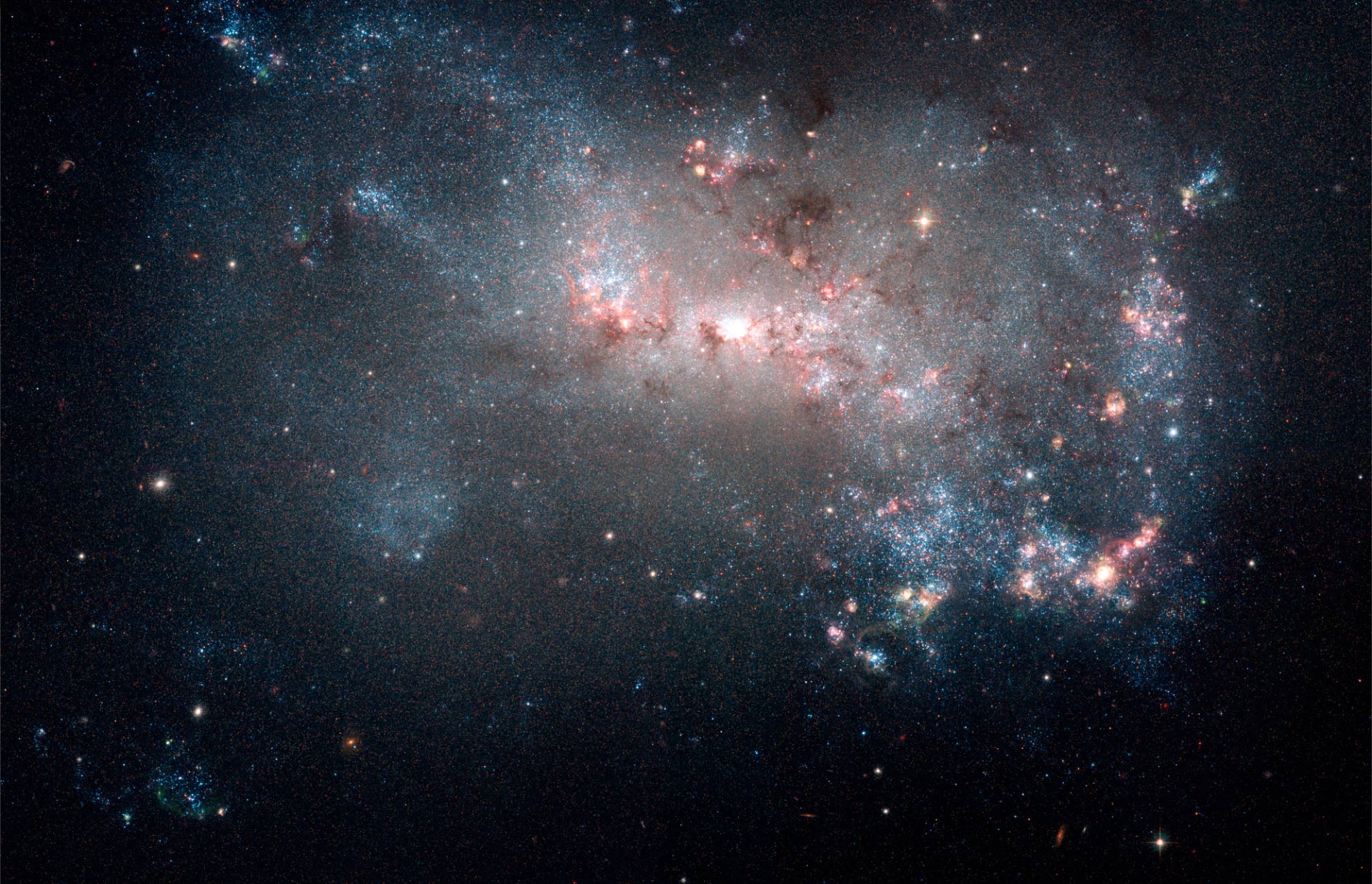
This Hubble image shows NGC 4449, one of the dwarf galaxies in the Galaxies Losing Oxygen via Winds (GLOW) study. Image credit: NASA / ESA / Hubble Heritage-ESA / Hubble Collaboration / Alessandra Aloisi, STScI & ESA.
“Oxygen is produced by stars, which are inside of galaxies,” said Dr. Grace Telford, an astronomer at the University of Utah.
“We know that the oxygen had to be inside of the galaxies at some point in the past, so the oxygen must have been ejected.”
“And to do that, you need energy from massive stars and supernova explosions to drive material out of the host galaxies and into the space between galaxies.”
As part of the Galaxies Losing Oxygen via Winds (GLOW) project, Dr. Telford and colleagues looked at dwarf galaxies within roughly 19.5 million light-years of Earth, with stellar masses from about 3 million to 3 billion times that of the Sun.
To work out how much oxygen each galaxy should have, they used the Hubble observations of individual stars to reconstruct each galaxy’s star formation history.
They then tallied how much oxygen is actually present in the galaxies’ gas, stars and dust.
The galaxies retained between 4% and 25% of the oxygen produced by their stars, with a mean of about 11%.
Nearly all of the retained oxygen sits in the gas rather than in stars or dust.
The rest was presumably expelled by supernova-driven outflows, a long-standing idea that the current study puts firm numbers on.
Galaxies more than 3.3 million light-years from a massive neighbor consistently retained less than 15% of their oxygen.
Those in denser surroundings or within 3.3 million light-years of a big galaxy showed more scatter, including most of the highest retention values.
This could mean oxygen is being recycled back into these galaxies, or that they are accreting gas already enriched by their neighbors.
Is the missing oxygen in the halo of gas around each galaxy, the circumgalactic medium, or has it escaped entirely?
Earlier ultraviolet observations of a highly ionized form of oxygen account for roughly 1-7% of what the galaxies produced.
After correcting for other ionization states, the authors estimate the halos could hold 5-35%, so a large share may still have left the galaxies’ gravitational reach.
The astronomers also compared their results with three cosmological simulations.
All three reproduce the mass-metallicity relation, but they predict that dwarf galaxies keep more of their metals than the observations show.
Using a simple galaxy-evolution model, they found that the data are best matched when outflows carry away proportionally more mass from smaller galaxies, the outflowing gas is about twice as metal-rich as the galaxy’s interstellar medium, and gas accretion onto these galaxies is suppressed by about 40%.
“So, it’s really for practical reasons that we’ve chosen oxygen,” said GLOW principal investigator Dr. Kristen Wingfield McQuinn, mission head of the Science Operations Center for NASA’s Nancy Grace Roman Space Telescope at the Space Telescope Science Institute and an astronomer at Rutgers University.
“Oxygen is one of the primary elements formed by stars. Being able to trace how much oxygen gets made, and then how much is distributed inside and outside of galaxies, helps us understand galaxy evolution.”
“It also helps us learn where and how much galaxies are enriching the space between galaxies, called the intergalactic medium.”
The results were published in the Astrophysical Journal.
_____
Kristen B.W. McQuinn et al. 2026. GLOW. II. A Census of Oxygen in Low-mass Galaxies. ApJ 1011, 158; doi: 10.3847/1538-4357/ae93a6