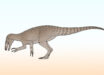
Astronomers using the NSF-DOE Vera C. Rubin Observatory have found what may be a new dwarf planet in the outer Solar System. The large, icy object carries the provisional name 2026 ED138 (ED138 for short).
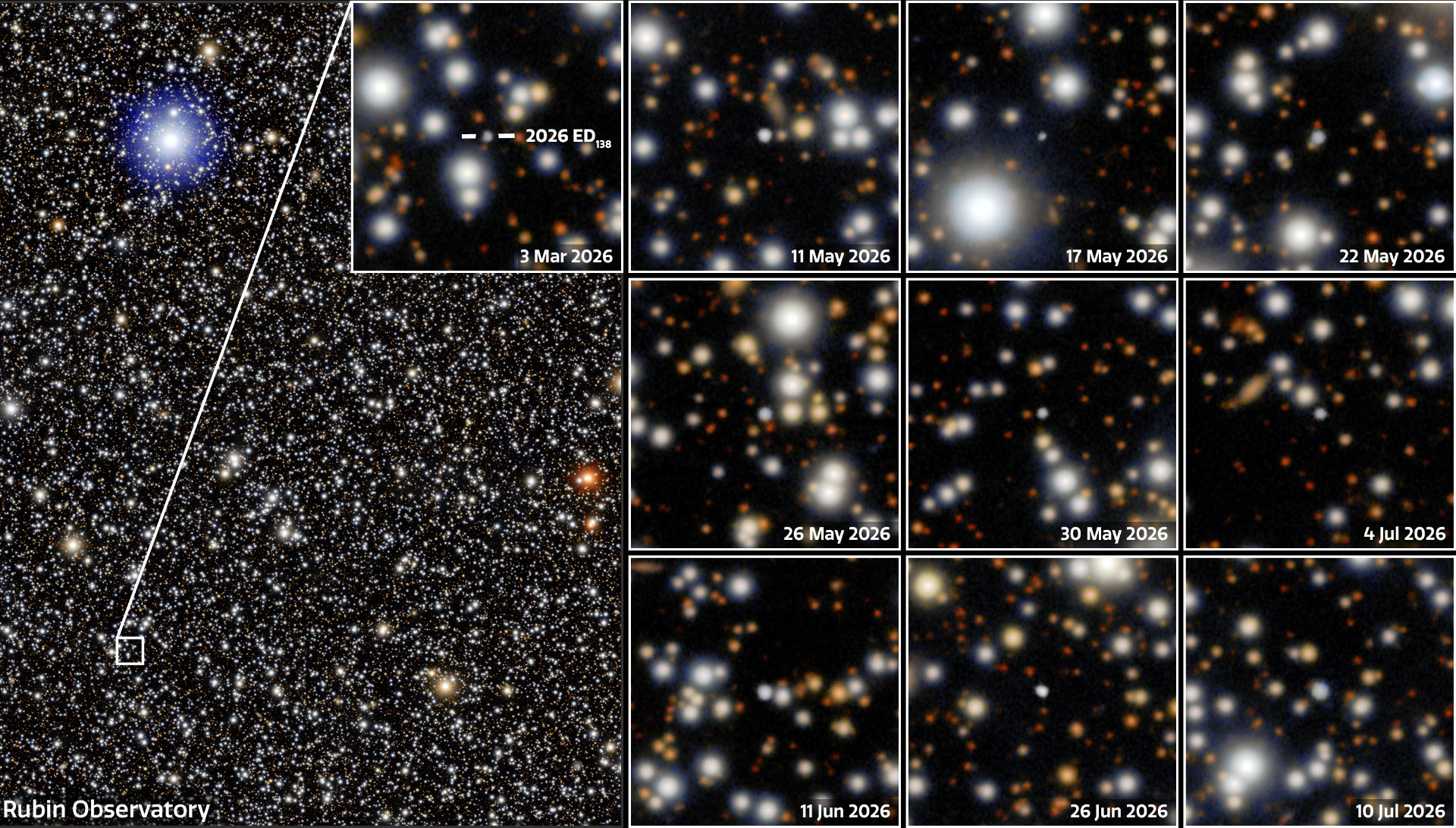
A mosaic of images captured by the Vera Rubin Observatory of 2026 ED138. Image credit: NSF / DOE / Vera C. Rubin Observatory / NOIRLab / SLAC / AURA / M. Jurić, University of Washington / D. de Martin & M. Zamani, NSF’s NOIRLab.
“Rubin is giving us an unprecedented capacity to explore the sky through a combination of speed, depth, and precision,” said Dr. Mario Jurić, Rubin’s solar system lead scientist at the University of Washington.
“And the discovery is just the beginning: once we identify a new object, we can search back months, and sometimes even decades, finding it in images where nobody knew to look.”
“This ability to both discover and ‘precover’ objects is transforming how quickly and accurately we can determine their orbits and understand the distant Solar System.”
Dr. Jurić and his colleagues estimate ED138 is between 600 and 1,500 km (373-932 miles) across, based on its brightness, distance and assumed reflectivity.
Icy bodies that big should be pulled into a round shape by their own gravity, one of the requirements for dwarf planet status.
Infrared observations will be needed to pin down its true size. If it is confirmed, ED138 would join Pluto, Ceres, Eris, Haumea and Makemake as the sixth dwarf planet.
“Rubin Observatory’s super power is the ability to clearly capture movement and change among a vast number of objects and phenomena that humans have never seen before,” said Dr. Edward Ajhar, NSF program director for Rubin Observatory.
“That power greatly extends our ability to reveal and understand new things about our Solar System, the Milky Way, and billions of other galaxies across the Universe.”
“Rubin Observatory’s unique strengths make it an incredible tool for investigating a wide range of astrophysical phenomena, from dark energy to the discovery of this dwarf planet candidate,” added Dr. Kathy Turner, DOE’s program manager for Rubin Observatory.
ED138 is currently about 46 AU (astronomical units) from the Sun, with one astronomical unit being the average Earth-Sun distance. For reference, Pluto has an average distance of 40 AU.
This puts the dwarf planet candidate in the realm of trans-Neptunian objects, the icy bodies that orbit beyond Neptune.
The orbit is tilted nearly 25 degrees from the plane of the Solar System. This makes ED138 a ‘hot-classical’ Kuiper Belt object, a group thought to have been nudged off course by Neptune’s gravity.
Such a large object went unnoticed because it sits in a part of the sky near the Milky Way’s plane, crowded with millions of stars.
Rubin’s repeated scans of the southern sky and its software for picking out faint movers made the find possible.
“If confirmed as a dwarf planet, ED138 would join a very small family of worlds,” said Dr. Matthew Holman, an astronomer at the Harvard & Smithsonian’s Center for Astrophysics.
“Rubin will image the whole southern sky again and again for ten years, so any others hiding in the places earlier surveys skipped are now within reach.”
_____
M. Juric et al. 2026 ED138. MPEC 2026-U85