Astronomers using the NASA/ESA/CSA James Webb Space Telescope have captured a spectacular new view of N159, one of the richest HII complexes in the Large Magellanic Cloud.
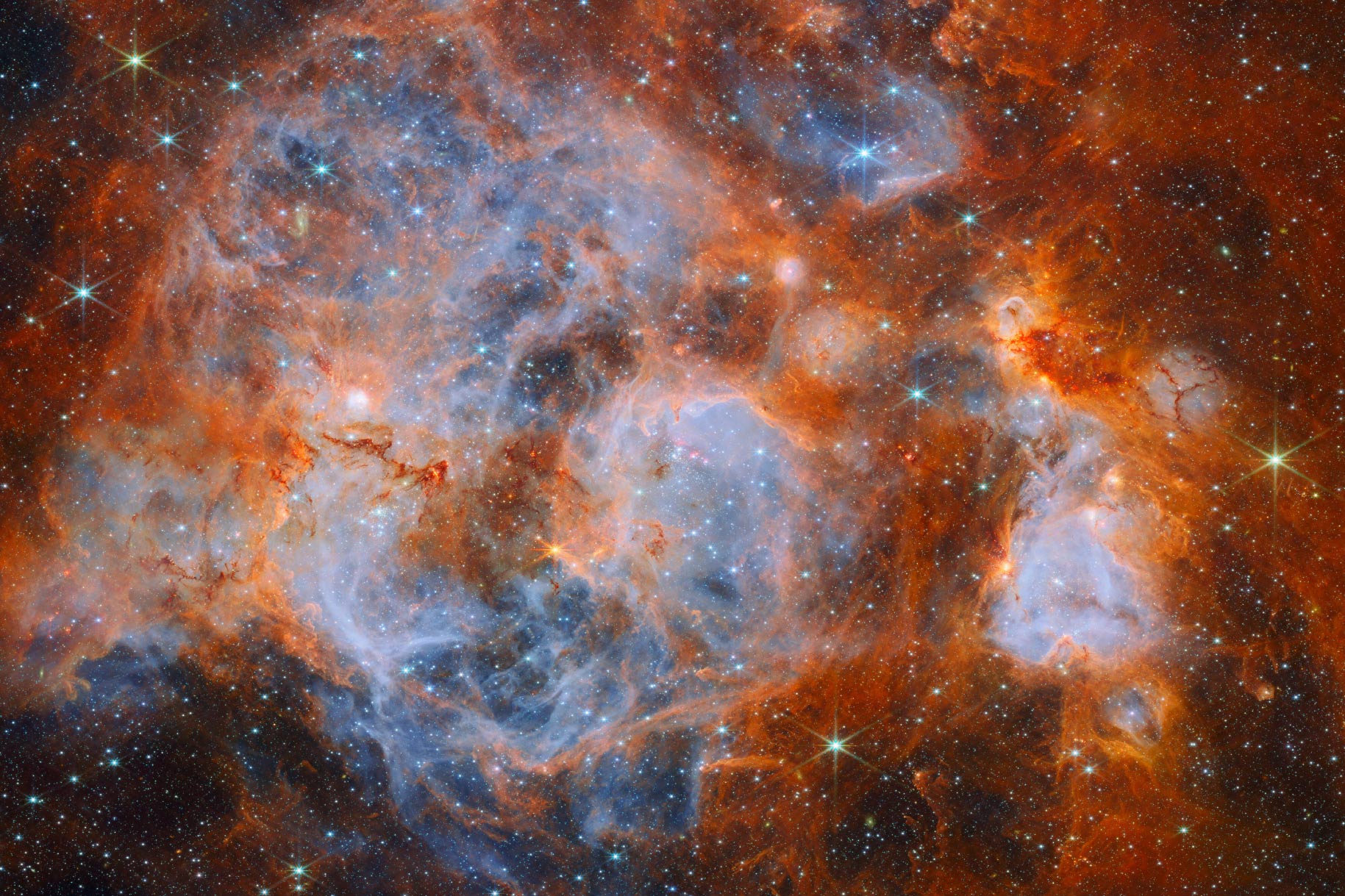
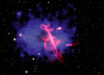
This Webb shows N159, a star-forming region within the Large Magellanic Cloud. Image credit: NASA / ESA / CSA / Webb / E. Sabbi / M. Zamani, ESA & Webb / M.H. Özsaraç.
Located about 161,000 light-years from Earth in the Large Magellanic Cloud, a satellite galaxy of the Milky Way, N159 stretches across approximately 230 light-years.
The complex is less than 3 million years old and contains thousands of stars at early stages of their evolution.
“In stellar nurseries such as this one, giant molecular clouds of cold hydrogen gas collapse under gravity, forming new stars,” said Dr. Nolan Habel, an astronomer at NASA’s Jet Propulsion Laboratory and Caltech, and his colleagues.
“Many of these stars are extremely massive and hot, and their powerful ultraviolet radiation ionizes the gas around them.”
“This makes HII regions markers of active star formation, and as the ionized gas radiates light this turns them into the kind of brilliant emission nebula that we see in this image.”
Captured with Webb’s Near-Infrared Camera (NIRCam), the image reveals intricate structures carved into N159 by intense radiation and powerful stellar winds.
Pale blue areas mark clouds of ionized hydrogen, while smoky orange regions glow with infrared emission from polycyclic aromatic hydrocarbons, carbon-based molecules.
Dark red filaments of cool molecular hydrogen weave through the scene, forming dense structures that help shield newborn stars from the harsh radiation of their massive neighbors.
“These filaments are the densest part of the nebula and currently shield new stars from harsh radiation and stellar winds — by zooming in, you can see stars as points of light embedded in these filaments and in the small pillars of orange gas that reach out into the blue bubbles,” the astronomers said.
“Eventually, these structures will melt away, leaving their completed stars behind.”
The researchers were able to distinguish young stars still embedded in their birth clouds from older, more evolved stellar populations.
The data revealed extremely faint stars with masses below one-tenth that of the Sun.
The scientists found that the western portion of N159 contains a more concentrated population of young stellar objects than the eastern region, suggesting that star formation there is at an earlier stage.
“With the whole sequence of star formation taking place at once, N159 is a unique place to see the evolution of a collapsing molecular cloud up close,” they concluded.
Their paper was posted on September 22, 2026 on the arXiv.org preprint server.
_____
Nolan Habel et al. 2026. Sequential Star-Formation and the Near-Infrared Stellar Populations within N159. arXiv: 2609.27126