Bats make up more than one fifth of all living mammal species, yet where and when they first took to the air has been debated for decades. An analysis of 103 bat genomes points to the European continent as the birthplace of the only mammals capable of powered flight, overturning earlier theories that favored Africa, Asia or North America. The findings come from the Bat1K consortium, an international effort to sequence the genomes of all living bat species.
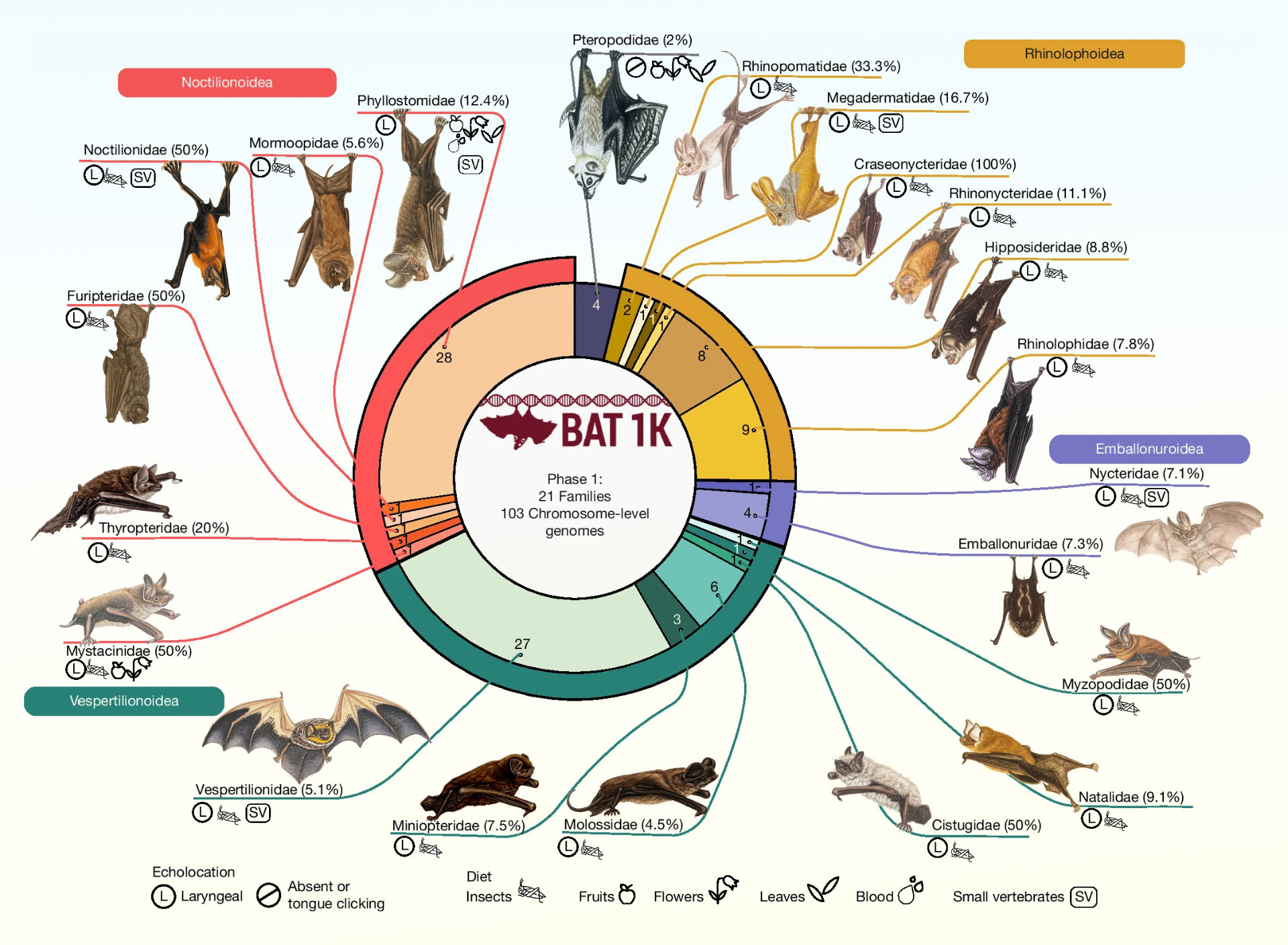
The first phase of the Bat1K project: 103 chromosome-level genome assemblies and annotations representing at least one species from each of the 21 currently recognized bat families. Image credit: Morales et al., doi: 10.1038/s41586-026-11007-3.
“Bats constantly surprise us,” said Professor Sonja Vernes, Bat1K director and a researcher at the University of St Andrews.
“They are one of evolution’s greatest experiments. This extraordinary genomic resource is finally allowing us to understand how their remarkable biology evolved.”
“Bats have ruled the night skies for about 65 million years, but working out where they first took flight has been more difficult to resolve,” said University of New South Wales Professor Suzanne Hand.
“Advances in genome sequencing and computing have now allowed us to compare and combine data from the DNA of living bats with the fossil record in a way that wasn’t previously possible.”
“That has given us a much clearer picture of the early bat family tree — and points to Europe as the place where bats first took flight.”
In the first phase of the Bat1K project, the researchers analyzed high-quality, chromosome-level genome assemblies from 103 species, 42 of them newly produced.
They combined that genetic data with a dataset of 699 anatomical characters drawn from 65 species, including 44 fossil species that predate the Quaternary period.
Using statistical models that account for the ages of the fossils, the scientists concluded that the ancestor of all bats lived in Europe in the Late Paleocene.
The analysis assigned a 99.2% probability to a European origin and rejected earlier proposals that placed bat origins in Africa, Asia or North America.
The major bat lineages appear to have diversified within a narrow window in the Early Eocene, around 56 million years ago.
This period coincided with the Paleocene-Eocene Thermal Maximum, a sharp episode of global warming.
“The approach we used to model the evolution of fossil and living species together can do what other methods cannot: identify the oldest group of fossil bats while taking the genomic data into account, and uncover when and where bats originated,” said Professor Liliana Dávalos, a researcher at Stony Brook University.
The Bat1K team also addressed one of the field’s most persistent questions: whether the ability to echolocate, using sounds produced in the larynx, evolved before or after bats diversified.
The authors placed a fossil species called Vielasia in the oldest branch of the bat family tree. This indicates that laryngeal echolocation predates the diversification of modern bats, suggesting a close link between flight and echolocation in the earliest bats.
“For decades there has been a question as to which came first in bats — flight or echolocation — and this is because bats cannot fly at night without some change in perception to enable flight in the dark,” Professor Dávalos said.
“Our analysis shows that the oldest branch of bats already had species that unambiguously echolocated.”
“Therefore, based on the tree with these fossils bat echolocation evolved shortly after mammalian flight did.”
The genomic data analyzed by the researchers also helped reorganize the bat family tree.
They place a family known as Myzopodidae, found on Madagascar, at the earliest branch within the superfamily Vespertilionoidea.
They also identify two other superfamilies, Emballonuroidea and Vespertilionoidea, as sister groups.
“It is extraordinary, after decades of research and conflicting findings, we finally have a robust phylogenetic tree that we can now use to properly understand how bats’ unique traits evolved,” said Professor Emma Teeling, a researcher at University College Dublin and co-founding director of the Bat1K consortium.
“We also have the genomes to uncover the molecular basis of these spectacular adaptations and know where the fossil bats fall in this tree.”
Other results from the Bat1K team concern where bats crossed oceans.
The analysis favors a route from Europe to North America across the North Atlantic around 54 million years ago for one major group, the superfamily Noctilionoidea, rather than a passage via the Bering region.
It also rejected the idea that bats reached South America by island-hopping from Africa.
“Instead, the timing and route of noctilionoids reaching the Americas coincides with the expansion of the tropics in the middle latitudes of the Americas and Europe and the beginning of the uplift of islands of the Panama isthmus, providing habitat and a North American route for this radiation of bats,” the scientists said.
The results appear today in the journal Nature.
_____
A.E. Morales et al. Reference genomes and fossils revise bat family phylogeny and biogeography. Nature, published online September 23, 2026; doi: 10.1038/s41586-026-11007-3