Astronomy News

Jul 9, 2020 by Enrico de Lazaro

A team of astronomers in Japan has detected 12 stellar flares, including a so-called superflare, on AD Leonis, an M-dwarf star located just 16 light-years away in the constellation of Leo. An artist’s impression of the flaring red dwarf AD Leonis, also known as Gliese 388 and BD+20 2465. Image credit: National Astronomical Observatory of Japan. “Stellar flares are sudden explosions that emanate from the surfaces of stars, including our own Sun,”...

Jul 9, 2020 by Enrico de Lazaro

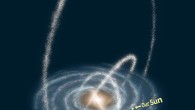
A team of astronomers from Israel and the United States has discovered a vast stream of 250 stars of extragalactic origin in the vicinity of our Solar...

Jul 9, 2020 by Natali Anderson

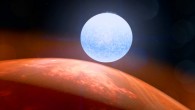
Astronomers using the SuperWASP-North telescope on La Palma in the Canary Islands, Spain, and the SOPHIE spectrograph at the Observatoire de Haute-Provence,...

Jul 8, 2020 by News Staff

Our Solar System contains a large population of icy bodies stretching well beyond the orbit of Neptune. These objects are remnants from the early formation...

Jul 7, 2020 by News Staff

Astronomers have analyzed a few carbon-oxygen white dwarfs in Milky Way’s old open clusters, and their findings help shed new light on the origin of...

Jul 6, 2020 by News Staff

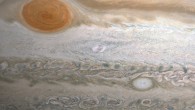
An astronomer from South Africa has discovered a new ‘white oval’ in the southern hemisphere of the gas giant Jupiter. Jupiter as captured...

Jul 6, 2020 by Natali Anderson

Using NASA’s Transiting Exoplanet Survey Satellite (TESS) and several ground-based telescopes, astronomers have discovered and confirmed a warm super-Neptune...

Jul 6, 2020 by Enrico de Lazaro

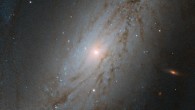
The NASA/ESA Hubble Space Telescope has captured a striking photo of a bright, barred spiral galaxy called NGC 7513. This Hubble image shows the barred...

Jul 3, 2020 by News Staff

Astronomers using the Atacama Large Millimeter/submillimeter Array (ALMA) and NSF’s Karl G. Jansky Very Large Array (VLA) have created the most detailed...

Jul 2, 2020 by News Staff

Using the Atacama Large Millimeter/submillimeter Array (ALMA) and the NASA/ESA Hubble Space Telescope, astronomers have observed G286.21+0.17, a massive...

Jul 2, 2020 by Enrico de Lazaro

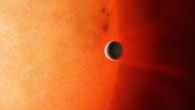
The newly-discovered planetary core, named TOI-849b, is a gas giant that was either stripped of its gaseous atmosphere or that failed to form one in its...

Jul 1, 2020 by News Staff

New observations from NASA’s Transiting Exoplanet Survey Satellite (TESS) have enabled astronomers to improve their understanding of the bizarre environment...

Jun 30, 2020 by Enrico de Lazaro

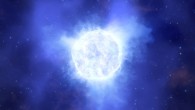
A new paper published in the Astrophysical Journal Letters points to the changes in the photosphere of the red supergiant star Betelgeuse as the source...

Jun 30, 2020 by News Staff

Using the X-SHOOTER and the ESPRESSO (Echelle Spectrograph for Rocky Exoplanet- and Stable Spectroscopic Observation) instruments on ESO’s Very Large...

Jun 29, 2020 by News Staff

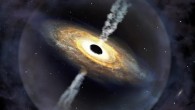
An international team of astronomers has discovered the second most distant quasar ever found. Named Pōniuā`ena and designated J100758.264+211529.207...

Jun 29, 2020 by Enrico de Lazaro

Astronomers using the NASA/ESA Hubble Space Telescope have captured a spectacular image of the spiral galaxy NGC 2775. This Hubble image shows a flocculent...

Jun 26, 2020 by Sergio Prostak

A team of astronomers from the RedDots project has discovered two super-Earths and a candidate planet orbiting the nearby 4.57-billion-year-old red dwarf...

Jun 26, 2020 by News Staff

Astronomers using the NASA/ESA Hubble Space Telescope have captured striking images of HBC 672’s unseen protoplanetary disk casting a huge shadow across...

Jun 25, 2020 by Sergio Prostak

The Breakthrough Listen Initiative, the largest ever scientific research program aimed at finding evidence of alien civilizations, has conducted a search...

Jun 25, 2020 by News Staff

The gravitational-wave signal GW190814, detected on August 14, 2019 by NSF’s Laser Interferometer Gravitational-Wave Observatory (LIGO) and the Virgo...